
Vadzo Imaging Positions Falcon-234CGS AR0234 2MP Color Global Shutter USB Camera for Electronic Component Inspection
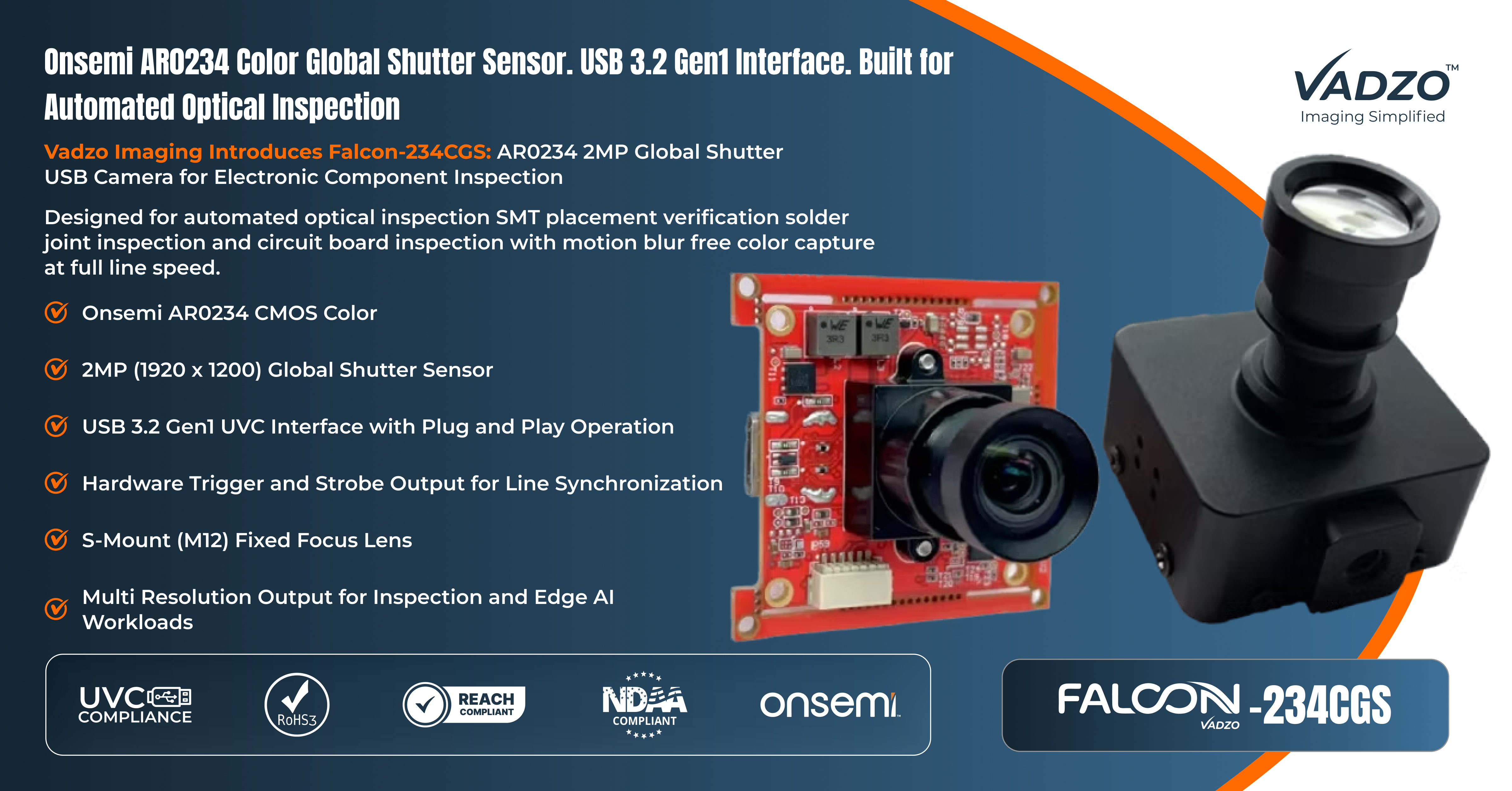 The Falcon-234CGS is a 2MP Onsemi AR0234 color global shutter USB 3.2 Gen1 camera built for electronic component inspection. It combines simultaneous pixel exposure with native UVC compliance and hardware trigger synchronization to give automated optical inspection systems distortion-free color frames at full conveyor line speed without proprietary drivers or manual focus adjustment.
FORT WORTH, TX / ACCESS Newswire / July 30, 2026 / Vadzo Imaging, a provider of embedded vision camera products for OEMs and system integrators, today introduced the 2MP Global Shutter USB Camera, the Falcon-234CGS, built on the Onsemi AR0234 Camera sensor platform for electronic component inspection stations across SMT placement verification, solder joint inspection, and circuit board quality control. The AR0234 USB Camera combines simultaneous pixel exposure with native UVC compliance and hardware trigger synchronization, giving automated optical inspection pipelines distortion-free color frames across the full range of conveyor speeds and lighting conditions found on a modern SMT line.
Technical Problem Definition: Motion Skew and Color Loss in Line Speed Inspection
Automated optical inspection systems face two engineering problems that a standard fixed-focus surveillance camera cannot solve at once. First, a printed circuit board moving through a placement or inspection station rarely stops the camera. Rolling shutter sensors expose and read out pixel rows sequentially, so a board captured mid-motion produces a frame with geometric skew that hides the fine edge detail a defect detection camera must resolve to flag a missing pad, a lifted lead, or a bridged solder joint. Second, many defects on an SMT line are identified by color rather than shape alone. A cold solder joint often carries a duller gray tone than a properly reflowed joint, a wrong-value resistor shows a different color band sequence, and a missing part leaves a bare pad that only a color sensor can distinguish reliably from the surrounding board finish. A monochrome global shutter camera solves the motion problem but discards the color information that a complete electronic component inspection camera decision depends on.
Sensor and Camera Overview
The Falcon-234CGS is Vadzo Imaging's answer to both problems in a single module. It is built on the Onsemi AR0234 CMOS color global shutter sensor, a 2MP (1920 x 1200) imager with a 1/2.6-inch optical format and 3.0 µm pixels. As a 2MP Global Shutter Camera, it exposes and reads every pixel at the same instant, eliminating the skew and wobble that a rolling shutter introduces on a moving conveyor. Because the AR0234 retains its native color filter array, the same frame that resolves component motion at full line speed also preserves the color cues an AR0234 AOI Camera needs to judge solder joint quality, verify resistor color bands, and confirm correct part placement against a reference image.
The camera pairs the AR0234 sensor with a high-performance ISP and an AR0234 Camera module housing that exposes a USB 3.2 Gen1 interface with full UVC compliance. The Falcon-234CGS enumerates as a standard video class device on Windows, Linux, and Android, so an inspection station builder can connect the AR0234 USB Camera directly to an industrial PC without a proprietary driver stack or frame grabber card. GPIO pins provide a hardware trigger input and strobe output, letting the camera fire in step with a conveyor encoder pulse or a placement head cycle rather than relying on free-running capture. A factory-fitted S-Mount (M12) lens holder ships with a fixed-focus lens calibrated for close-range component inspection, and any standard M12 optic can be substituted for different working distances.
Key specs: 2MP (1920 x 1200) | Onsemi AR0234 1/2.6 inch | 3.0 µm pixel | Color Global Shutter | Fixed Focus | USB 3.2 Gen1 UVC | 1080p / 720p / VGA Output Modes | S-Mount (M12) | Windows, Linux, and Android
Product Overview
The Falcon-234CGS packages the AR0234 sensor, ISP, fixed focus optics, and a USB 3.2 Gen1 UVC interface into a compact module sized for placement inside an AOI enclosure or a pick-and-place camera head. Where an earlier generation Onsemi AR0234 module in the Vadzo lineup relied on USB 2.0 for lighter-duty vision tasks, the Falcon-234CGS steps up to USB 3.2 Gen1 to give a 2MP USB Camera the bandwidth margin needed for higher frame rate streaming, simultaneous multi-camera deployment, and headroom for future resolution modes on the same inspection cell. The result is a 2MP Inspection Camera where a machine builder can drop into an existing station without redesigning the electrical or mechanical interface.
Key Capabilities of the Falcon-234CGS 2MP USB Camera
Global Shutter Eliminates Motion Blur on Continuously Moving Lines: Most entry-level inspection camera products use rolling shutters, which read out pixel rows in sequence and produce skewed or stretched frames whenever a board keeps moving during capture. The AR0234 global shutter exposes the full 2MP frame simultaneously, so a Motion Blur Free Camera result is the default outcome rather than a setting a technician must tune. As a Global Shutter USB Camera watching parts pass under a placement head at full line speed, the Falcon-234CGS removes the single largest source of false rejects and missed defects on vision-guided SMT lines, and it does so as a Global Shutter Inspection Camera without added processing overhead.
Color Imaging for Component and Solder Joint Verification: Because the AR0234 keeps its color filter array intact, the Falcon-234CGS resolves the color differences that a monochrome global shutter sensor cannot see. A Component Placement Camera task such as confirming a blue tantalum capacitor against a black ceramic part, or a solder inspection task such as separating a dull cold joint from a shiny reflowed one, depends on accurate color reproduction under consistent lighting. This makes the camera equally useful as a Semiconductor Component Camera for die and package level checks where subtle tint differences indicate a process defect.
USB 3.2 Gen1 Plug and Play Integration: The USB 3.2 UVC Camera interface connects directly to any USB 3.2 Gen1 host port on Windows, Linux, and Android without an additional frame grabber or interface board. UVC class driver support means the Falcon-234CGS streams immediately on connection, which shortens integration time for a UVC Inspection Camera deployment and lowers the total bill of materials cost across a multi-station AOI line.
Hardware Trigger and Strobe Synchronization for Line Speed AOI: A conveyor that never fully stops needs a camera that captures commands rather than on a fixed timer. GPIO-based hardware trigger input lets the Falcon-234CGS fire in sync with an encoder pulse or a placement head cycle, while the strobe output coordinates LED illumination to freeze motion and hold color consistency frame to frame. This turns the module into a dependable Global Shutter AOI Camera for stations where capture timing accuracy determines whether a defect is caught before the board moves to the next process step.
Compact S-Mount Form Factor for AOI and Pick and Place Camera Heads: The Falcon-234CGS ships in a compact module footprint with an S-Mount (M12) lens holder that accepts any standard M12 threaded optic. Machine builders can select a narrow field lens for tight component-level detail or a wider lens for full board coverage on the same OEM Inspection Camera platform. The small footprint fits inside space-constrained placement heads, gantry-mounted inspection arms, and Circuit Board Inspection Camera fixtures where clearance around the board is limited.
Flexible Resolution Modes for Throughput and Detail Balance: Selectable 1080p, 720p, and VGA output lets a single 2MP Component Inspection Camera serve more than one station on the same line. Full 1080p mode captures maximum detail for fine-pitch component and solder joint review, while the lower resolution modes support higher frame rate operation for coarse presence and placement checks earlier in the process. A Machine Vision AOI Camera configured this way lets an engineering team standardize one camera model across incoming inspection, in-process checks, and final assembly verification.
"Inspection engineers keep telling us the same thing. Rolling shutter skew ruins defect detection on a moving board, and a monochrome sensor throws away the color cues a solder joint or a component color band depends on. The Falcon-234CGS solves both at once. By pairing the AR0234 color global shutter with USB 3.2 Gen1 and hardware trigger support in a single module, we give AOI machine builders a camera that keeps up with the line and still sees color the way a human inspector would." - Alwin Vincent, Product Manager, Vadzo Imaging.
Applications
Automated Optical Inspection for SMT Lines: AOI stations placed after reflowing or after component placement need to catch defects before a board advances to the next process step. The Falcon-234CGS operates as an AOI Inspection Camera and an SMT Inspection Camera in the same module, delivering color global shutter frames that keep pace with belt speed while preserving the detail needed for component presence and orientation checks.
Solder Joint and Circuit Board Quality Control: Solder joint grading and trace-level board inspection both depend on consistent color rendition under repeatable lighting. As a Solder Joint Inspection Camera and a Circuit Board Inspection Camera, the Falcon-234CGS resolves the tone differences between a properly reflowed joint and a cold or bridged one, and the fixed focus S-Mount optics hold sharp detail at the close working distances typical of board-level inspection.
Electronic Component Inspection and Semiconductor Handling: Incoming component inspection and tape and reel handling equipment need to verify part markings, color codes, and package integrity before parts reach the placement machine. An Electronic Component Inspection Camera built around the AR0234 sensor identifies an AR0234 Component Camera target reliably at high throughput, and the same color accuracy supports semiconductor package inspection where surface tint or marking clarity indicates a manufacturing defect.
Component Placement and Pick and Place Verification: Pick-and-place machines benefit from a vision system that confirms part orientation and placement accuracy without slowing the head cycle. The global shutter capture of the Falcon-234CGS 2MP USB Camera supports Component Placement Camera verification immediately after each placement event, and the hardware trigger input keeps capture timing locked to the machine cycle rather than a fixed internal clock.
OEM Machine Vision Integration: Machine builders assembling a custom inspection cell need a camera that drops into an existing electrical and mechanical interface without a redesign. The Falcon-234CGS serves as a Machine Vision AOI Camera and an OEM Inspection Camera platform, with UVC compliance, S-Mount optics, and GPIO trigger support that match the conventions most AOI system integrators already use across their existing camera fleet.
Frequently Asked Questions
Q: Why does automated optical inspection need a color image rather than grayscale detail alone?
A: Many inspection decisions on an SMT line are made by color, not shape. A resistor color band sequence, a capacitor body color, and the visual difference between a properly reflowed solder joint and a cold or bridged one all rely on accurate color reproduction. Vadzo Imaging designs its inspection camera products to keep the sensor's native color filter array intact rather than stripping it out for a marginal noise gain, because a manufacturing line that loses color information also loses the ability to catch a category of defects that grayscale contrast alone cannot reveal. Pairing that color accuracy with a global shutter means an inspection station gets both the detail and the motion integrity a moving board demands, without asking a quality team to choose one over the other.
Q: How does hardware trigger synchronization improve accuracy on a fast-moving inspection line?
A: A camera that captures on a free-running timer will occasionally fire while a board is still settling into position or already moving toward the next station, producing a frame that is technically sharp but functionally useless for a placement or defect check. Hardware trigger input ties image capture directly to a physical event, such as a conveyor encoder pulse or a placement head completing its cycle, so every frame lands at the right moment in the process. Vadzo Imaging builds this trigger and strobe capability into its inspection camera products because repeatable timing, not just resolution, is what separates a dependable automated inspection station from one that generates false rejects and requires constant manual review.
Q: What determines whether a camera can catch small defects on a densely packed circuit board?
A: Detecting a small defect, such as a hairline solder bridge or a slightly rotated fine-pitch component, depends on how many pixels fall across the feature at the chosen working distance, not on megapixel count alone. A sensor with the right balance of resolution and pixel size delivers enough spatial detail at typical inspection distances without producing more data than the line processing budget can handle in real time. Vadzo Imaging selects sensors and lens combinations for its camera products specifically to hit that balance, so a manufacturing engineer gets dependable defect resolution at production line speed rather than a camera that only performs well in a lab demonstration.
Q: Can one camera model cover incoming component checks and final assembly verification on the same line?
A: Yes. A camera that supports multiple selectable output resolutions can serve multiple inspection roles without changing hardware. A manufacturing team can run full resolution capture for fine detail work such as solder joint grading, then switch to a lower resolution and higher frame rate mode for faster presence orientation checks earlier in the process. Vadzo Imaging designs its inspection camera products around this flexibility so that a machine builder can standardize a single camera platform across an entire line rather than qualifying and stocking a different model for every inspection station.
Q: How does Vadzo Imaging support OEM machine builders in integrating a new inspection camera into an existing station?
A: Vadzo Imaging ships every inspection camera factory calibrated with a mounted lens, validated UVC drivers, and working sample code, rather than a bare sensor board that still needs months of integration engineering. For OEM customers, Vadzo offers lens selection support, cable and connector configuration, and firmware-level customization so a machine builder can standardize hardware across an entire product line instead of managing a different camera for every station variant. Evaluation units are available with no minimum order requirement, and Vadzo's engineering team works directly with integrators through bring-up and qualification; a new inspection station reaches production faster and with fewer surprises.
Availability
The Falcon-234CGS 2MP Global Shutter USB Camera built on the Onsemi AR0234 sensor is available now for evaluation and production orders. Evaluation kits include the camera module, S-Mount fixed-focus lens, USB 3.2 Gen1 cable, and platform driver documentation with no minimum order requirement. Browse the full Vadzo camera portfolio at https://www.vadzoimaging.com/ or contact Vadzo at [email protected] to request an evaluation kit or discuss OEM integration requirements.
About Vadzo Imaging
Vadzo Imaging is a global provider of embedded vision solutions and delivers high-performance camera technologies and imaging platforms for applications in robotics, industrial automation, UAVs, edge AI, and medical systems. Its camera products are designed for seamless integration with leading embedded platforms. Vadzo supports customers through hardware customization, firmware development, and module-level drivers, enabling faster development and deployment of vision-based inspection systems.
Media Contact
Alwin Vincent
Vadzo Imaging
Email: [email protected]
LinkedIn: Vadzo Imaging
YouTube: Vadzo Imaging
X: Vadzo Imaging
SOURCE: Vadzo Imaging