
Tylosin Market Forecast 2026-2036: Market to Reach USD 1.3 Billion by 2036 at 4.9% CAGR
 Rising regulatory pressure on antimicrobial use and shift toward targeted therapeutic livestock treatment reshape global market dynamics
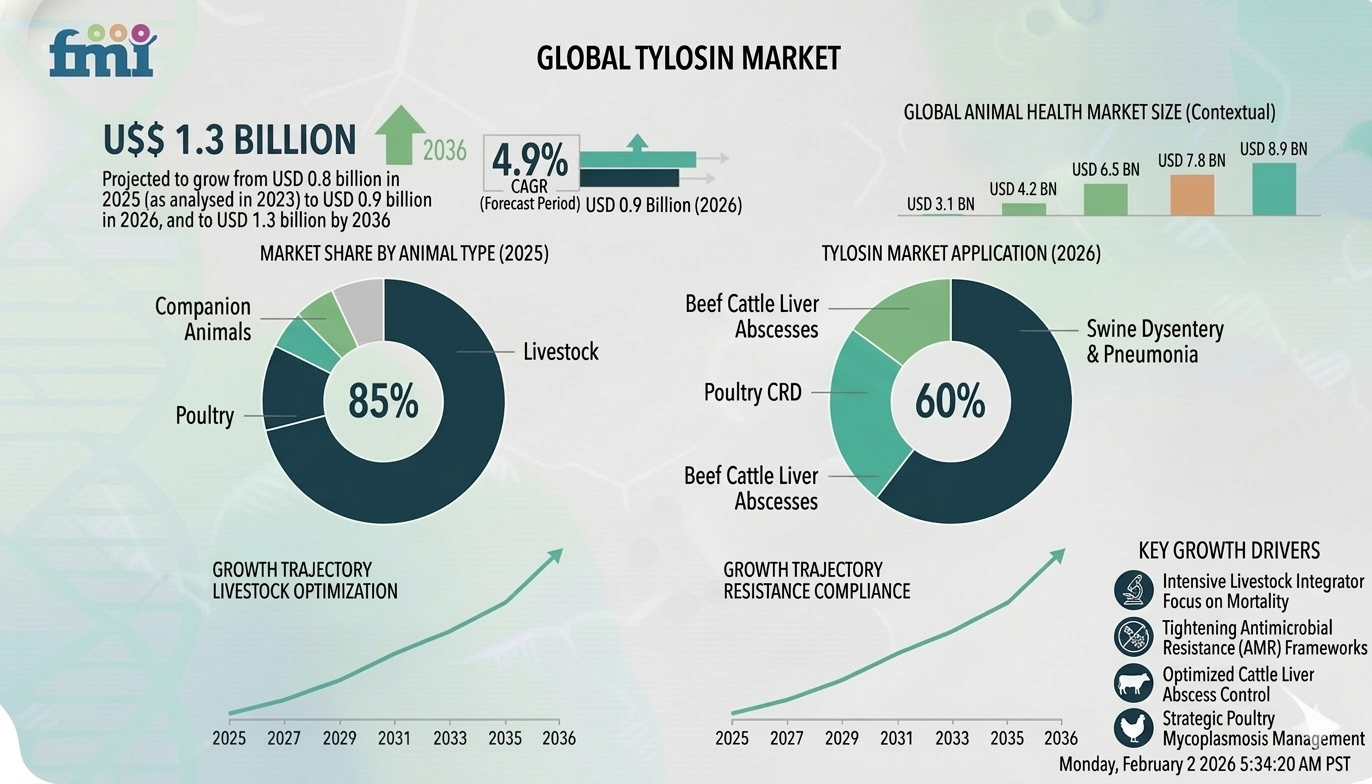
NEWARK, DE / ACCESS Newswire / March 17, 2026 / The global tylosin market is set to witness steady expansion over the next decade, growing from USD 0.9 billion in 2026 to USD 1.3 billion by 2036, registering a CAGR of 4.9% during the forecast period. According to the latest analysis by Future Market Insights (FMI), increasing regulatory scrutiny on antimicrobial resistance and the transition from continuous prophylactic use to targeted therapeutic intervention are key factors driving market evolution.
Tylosin, a veterinary-specific macrolide antibiotic, plays a critical role in maintaining productivity in high-density livestock farming. However, evolving global regulatory frameworks are forcing livestock integrators to adopt precision dosing strategies, shifting away from traditional feed-based continuous administration toward water-soluble therapeutic formulations.
Get Access of Report Sample: https://www.futuremarketinsights.com/reports/sample/rep-gb-32312
Tylosin Market Snapshot (2026-2036)
Market size in 2026: USD 0.9 billion
Market size in 2036: USD 1.3 billion
CAGR (2026-2036): 4.9%
Leading type segment: Tylosin Tartrate (55.0% share)
Leading application: Animal Feed Additives (60.0% share)
Top distribution channel: Drug Stores & Retail Pharmacies (45.0% share)
Key growth regions: Asia Pacific, North America, Latin America, Europe
Fastest-growing countries: India, China, Brazil, Australia, USA
Market Momentum
The tylosin market continues to expand as livestock producers adapt to stricter antimicrobial regulations while maintaining operational efficiency. In 2026, the market stands at USD 0.9 billion, supported by ongoing demand in intensive poultry and livestock operations.
By 2031, regulatory enforcement timelines begin to reshape procurement behavior, with integrators stockpiling high-purity active pharmaceutical ingredients and shifting toward rapid-clearance soluble formulations. This transitional phase drives temporary revenue spikes despite underlying volume moderation.
Between 2031 and 2036, the market stabilizes as digital veterinary prescription systems streamline compliance and enable precise therapeutic use. By 2036, the market reaches approximately USD 1.3 billion, supported by premium pricing for advanced formulations.
Why the Market Is Growing
The tylosin market is primarily driven by the need to balance livestock productivity with stringent antimicrobial resistance frameworks. Feed mill operators and farm managers are increasingly replacing broad-spectrum antibiotics with veterinary-specific macrolides to meet regulatory compliance.
Export-driven livestock industries are also pushing adoption of rapid-clearance formulations to meet strict residue testing standards. Failure to comply with these protocols can lead to rejection of entire production batches, significantly impacting profitability.
Additionally, the consolidation of livestock operations in emerging markets is accelerating demand for standardized dosing systems capable of managing large-scale herds efficiently.
Segment Spotlight
Type: Tylosin Tartrate Leads with 55.0% Share
Tylosin tartrate dominates due to its high solubility, enabling immediate herd-wide dosing through water systems during acute disease outbreaks. This eliminates delays associated with feed-based delivery and ensures rapid therapeutic action.
Application: Animal Feed Additives Hold 60.0% Share
Animal feed additives remain the dominant application segment due to their operational efficiency. Centralized feed mill integration allows standardized dosing across large farming networks while minimizing labor requirements.
Distribution Channel: Retail Pharmacies Lead (45.0% Share)
Drug stores and retail pharmacies play a crucial role, particularly for independent farmers who rely on local veterinary supply networks for immediate access and flexible purchasing options during disease outbreaks.
Regional Growth Outlook
Asia Pacific leads global growth, driven by rapid industrialization of livestock farming and increasing protein demand. India is projected to grow at a CAGR of 7.2%, supported by the formalization of poultry operations, followed by China at 6.8%.
Brazil emerges as a key growth market in Latin America, expanding at 5.8% CAGR due to its export-oriented livestock industry. Meanwhile, developed markets such as the United States (4.5%) and Germany (3.9%) reflect slower growth due to stringent antimicrobial reduction policies.
Drivers, Opportunities, Trends, Challenges
Drivers:
Rising antimicrobial resistance regulations
Expansion of intensive livestock farming
Increasing export compliance requirements
Opportunities:
Digital veterinary prescription platforms
Rapid-clearance and residue-optimized formulations
Advanced water-line dosing infrastructure
Trends:
Shift from prophylactic to therapeutic antibiotic use
Integration of digital compliance systems in livestock management
Growing demand for high-purity, traceable APIs
Challenges:
Regulatory bottlenecks in veterinary prescriptions
Supply chain complexities for active pharmaceutical ingredients
High compliance costs for farmers and integrators
Country Growth Outlook (CAGR 2026-2036)
Country
CAGR
India
7.2%
China
6.8%
Brazil
5.8%
Australia
5.0%
USA
4.5%
Germany
3.9%
Japan
3.2%
Competitive Landscape
The tylosin market is characterized by a concentrated competitive structure, with leading players focusing on supply chain reliability, regulatory compliance, and advanced formulation capabilities.
Key companies operating in the global market include Elanco Animal Health Inc., Zoetis Inc., Ceva Santé Animale, Phibro Animal Health Corporation, Huvepharma AD, Vetoquinol S.A., and Shandong Lukang Pharmaceutical Co. Ltd.
These companies compete on the basis of high-purity API production, global distribution capabilities, and the ability to navigate complex veterinary regulatory frameworks across multiple regions.
For an in-depth analysis of evolving formulation trends and to access the complete strategic outlook for the Tylosin Market through 2036 , visit the official report page at: https://www.futuremarketinsights.com/reports/tylosin-market
Explore More Research Reports by FMI:
Animal Antibiotics and Antimicrobials Market: https://www.futuremarketinsights.com/reports/animal-antibiotics-and-antimicrobials-market
Companion Animal Vaccines Market: https://www.futuremarketinsights.com/reports/companion-animal-vaccines-market
Over-The-Counter (OTC) Veterinary Drugs Market: https://www.futuremarketinsights.com/reports/over-the-counter-otc-veterinary-drugs-market
Pet CBD Market: https://www.futuremarketinsights.com/reports/pet-cbd-market
Veterinary Vaccines Market: https://www.futuremarketinsights.com/reports/veterinary-vaccines-market
About Future Market Insights (FMI)
Future Market Insights (FMI) is a leading provider of market intelligence and consulting services, serving clients in over 150 countries. Headquartered in Delaware, USA, with a global delivery center in India and offices in the UK and UAE, FMI delivers actionable insights to businesses across industries including automotive, technology, consumer products, manufacturing, energy, and chemicals.
An ESOMAR-certified research organization, FMI provides custom and syndicated market reports and consulting services, supporting both Fortune 1,000 companies and SMEs. Its team of 300+ experienced analysts ensures credible, data-driven insights to help clients navigate global markets and identify growth opportunities.
For Press & Corporate Inquiries
Rahul Singh
AVP - Marketing and Growth Strategy
Future Market Insights, Inc.
+91 8600020075
For Sales - [email protected]
For Media - [email protected]
For web - https://www.futuremarketinsights.com/
SOURCE: Future Market Insights, Inc.