
Global Robotics-Ready Fulfillment Center Design and Integration Services Market Outlook 2026-2036: Automation-Driven Warehousing to Expand at 9.9% CAGR
 Automation-Led Warehouse Transformation Accelerates Demand for Integrated Robotics Design, Simulation, and Software Orchestration Services
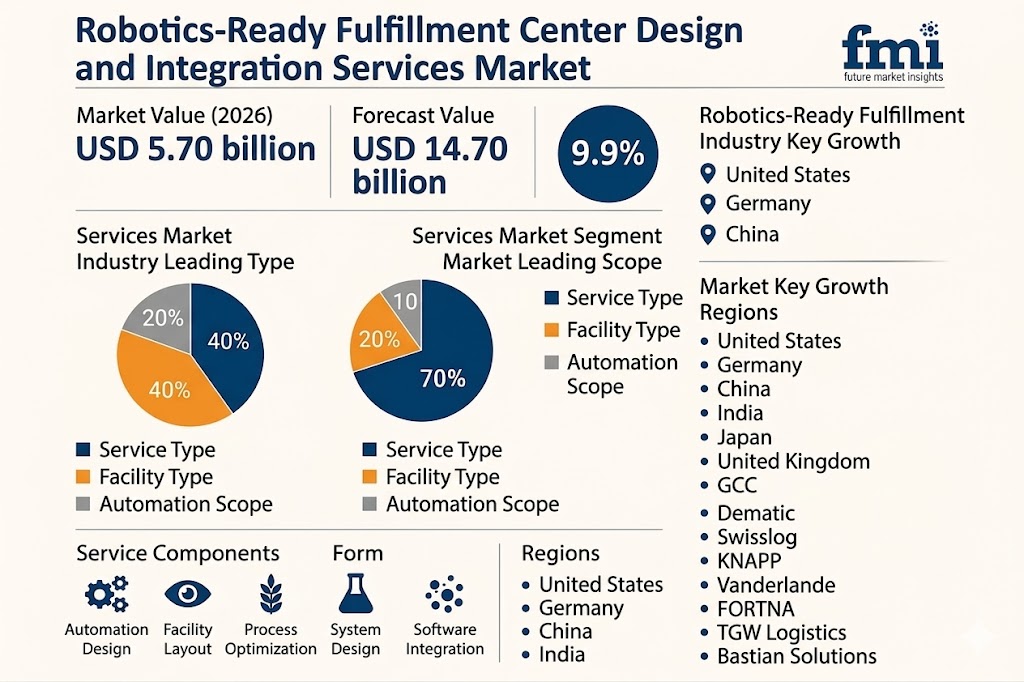
NEWARK, DE / ACCESS Newswire / March 30, 2026 / The global robotics-ready fulfillment center design and integration services market is witnessing accelerated growth as supply chains undergo a structural transformation toward automation-first architectures. Valued at USD 5.70 billion in 2026, the market is projected to reach USD 14.70 billion by 2036, expanding at a robust CAGR of 9.9%, according to Future Market Insights (FMI).
This surge reflects a decisive shift among logistics operators and retailers toward fully integrated, robotics-enabled warehouse ecosystems that prioritize speed, accuracy, and scalability in high-volume fulfillment environments.
Get Access of Report Sample: https://www.futuremarketinsights.com/reports/sample/rep-gb-32483
Market Overview: Engineering the Future of Autonomous Warehousing
The market encompasses advanced engineering services, simulation modeling, and software orchestration required to deploy robotics within fulfillment centers. Unlike traditional warehouse upgrades, this segment focuses on aligning infrastructure, automation hardware, and execution software before operational launch.
As fulfillment complexity increases, integrators are becoming critical partners in ensuring operational continuity and system compatibility.
Market Overview & Growth Forecast
Category
Details
Market Value (2026)
USD 5.70 Billion
Forecast Value (2036)
USD 14.70 Billion
CAGR (2026-2036)
9.9%
Core Value Proposition
Seamless integration of robotics, software, and facility design
Primary Growth Driver
E-commerce fulfillment speed and labor shortages
Demand Drivers: E-commerce Velocity and Labor Constraints
The rapid growth of e-commerce and omnichannel retail is placing unprecedented pressure on warehouse infrastructure. Key demand drivers include:
Rising fulfillment speed expectations, especially next-day and same-day delivery
Chronic labor shortages, accelerating adoption of goods-to-person systems
Escalating real estate costs, pushing high-density automated storage solutions
Complex fleet orchestration needs, requiring advanced integration expertise
These factors are compelling organizations to invest in robotics-ready facility designs that can support autonomous operations at scale.
Segment Insights: Design Engineering and E-commerce DCs Lead
FMI analysis highlights strong demand across key segments:
Service Type: Design engineering leads with 32% share, driven by reliance on digital twin simulations before hardware investment
Facility Type: E-commerce distribution centers dominate with 38% share, reflecting demand for high-speed piece-picking systems
Automation Scope: Goods-to-person systems account for 29% share, transforming picking productivity
End Users: Retailers lead with 34% share, driven by omnichannel fulfillment needs
Delivery Model: Turnkey projects dominate with 46% share, reducing multi-vendor complexity
These segments underscore the increasing importance of pre-deployment validation and integrated execution strategies.
Regional Analysis: India and China Drive High-Growth Momentum
Growth trends vary significantly by region, shaped by infrastructure maturity and automation readiness:
India (12.8% CAGR): Fastest-growing market driven by rapid logistics formalization and e-commerce expansion
China (11.2% CAGR): Massive online retail volumes fueling dense robotic grid deployments
United States (9.3% CAGR): Focus on replacing legacy sortation systems with flexible automation
United Kingdom (9.0% CAGR) & Germany (8.7% CAGR): Growth driven by brownfield automation and high labor costs
Japan (8.4% CAGR): Labor shortages accelerating fully autonomous warehouse adoption
Emerging markets are particularly attractive due to greenfield opportunities and rapid infrastructure development.
Technology Imperative: Software Integration as the Critical Path
While robotics hardware continues to evolve rapidly, industry experts emphasize that software orchestration remains the primary bottleneck in deployment timelines.
Key integration challenges include:
Compatibility between autonomous fleets and legacy warehouse management systems (WMS)
Real-time data processing requirements for fleet coordination and traffic management
Need for open API architectures to avoid vendor lock-in
Complex digital twin simulations for accurate facility planning
Integrators that can bridge these gaps are securing long-term contracts and strategic partnerships with major logistics operators.
Challenges: Legacy Systems and Integration Complexity
Despite strong growth, the market faces several structural challenges:
Outdated warehouse software architectures limiting real-time automation capabilities
High upfront investment costs for integration and simulation services
Vendor interoperability issues across fragmented automation ecosystems
Downtime risks during brownfield facility upgrades
Organizations attempting in-house integration often encounter delays, reinforcing the value of specialized service providers.
Competitive Landscape: Integration Expertise Defines Market Leadership
The competitive landscape is shaped by companies with strong software integration capabilities and proven deployment track records. Key players include:
Dematic
Swisslog
KNAPP
Vanderlande
FORTNA
TGW Logistics
Bastian Solutions
These firms leverage extensive libraries of validated integration protocols and simulation models to accelerate deployment timelines and ensure system reliability.
Strategic Outlook: From Hardware Procurement to System Orchestration
By 2036, the focus of warehouse automation will shift decisively from hardware acquisition to end-to-end system orchestration. Companies that prioritize integration-first strategies-combining robotics, software, and facility design-will achieve superior operational efficiency and scalability.
As supply chains become increasingly digitized and autonomous, robotics-ready fulfillment center design and integration services will emerge as a cornerstone of modern logistics infrastructure.
For an in-depth analysis of evolving formulation trends and to access the complete strategic outlook for the Robotics-Ready Fulfillment Center Design and Integration Services Market through 2036, Full Report Request: https://www.futuremarketinsights.com/reports/robotics-ready-fulfillment-center-design-and-integration-services-market
Related Reports:
Center-less Grinding Machines Market- https://www.futuremarketinsights.com/reports/center-less-grinding-machines-market
Agricultural Sprayers Market Share Analysis- https://www.futuremarketinsights.com/reports/agricultural-sprayers-market-share-analysis
Composite Roller Market- https://www.futuremarketinsights.com/reports/composite-rollers-market
About Future Market Insights (FMI)
Future Market Insights (FMI) is a leading provider of market intelligence and consulting services, serving clients in over 150 countries. Headquartered in Delaware, USA, with a global delivery center in India and offices in the UK and UAE, FMI delivers actionable insights to businesses across industries including automotive, technology, consumer products, manufacturing, energy, and chemicals.
An ESOMAR-certified research organization, FMI provides custom and syndicated market reports and consulting services, supporting both Fortune 1,000 companies and SMEs. Its team of 300+ experienced analysts ensures credible, data-driven insights to help clients navigate global markets and identify growth opportunities.
For Press & Corporate Inquiries
Rahul Singh
AVP - Marketing and Growth Strategy
Future Market Insights, Inc.
+91 8600020075
For Sales - [email protected]
For Media - [email protected]
For web - https://www.futuremarketinsights.com/
SOURCE: Future Market Insights, Inc.