
Vadzo Imaging Positions Sony STARVIS USB 2.0 Camera Products Purpose Built for Smart Agriculture Vision Systems
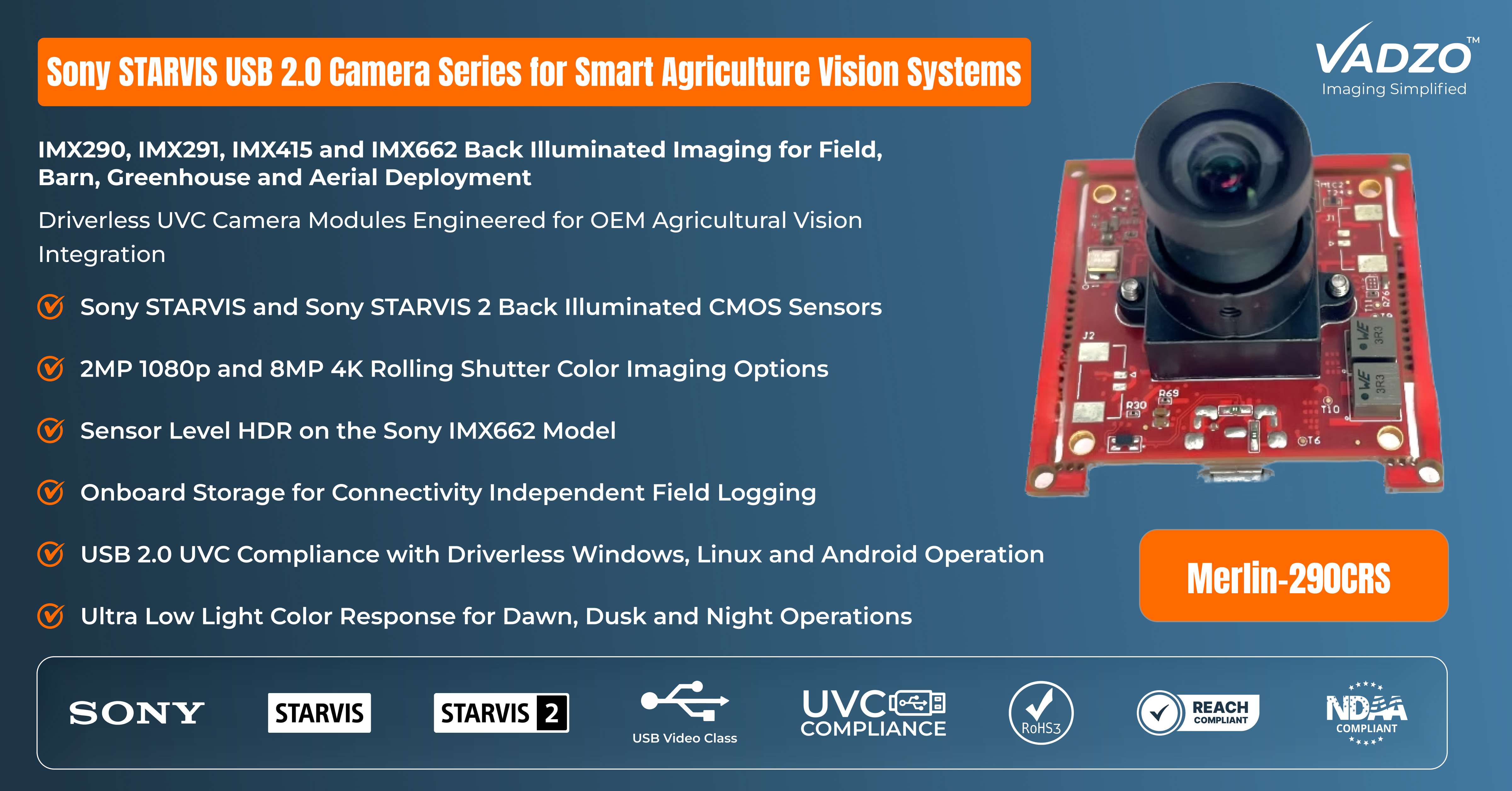 Vadzo Imaging expands its Merlin series with four back-illuminated imaging options for smart agriculture vision systems. The Sony IMX290, IMX291, IMX415 and IMX662 sensors form a Sony Starvis USB 2.0 Camera family that holds color response steady from first light through full darkness, delivering 1080p and 4K rolling shutter capture, sensor level HDR, onboard storage and driverless UVC operation for crop monitoring, precision agriculture, livestock housing, aerial survey and controlled environment work where ambient light cannot be engineered.
SAN JOSE, CA / ACCESS Newswire / August 6, 2026 / Vadzo Imaging, a global provider of embedded vision solutions, today announces four Sony STARVIS and Sony STARVIS 2 imaging options in its Merlin USB camera series for agricultural vision systems. The Merlin-290CRS, Merlin-291CRS, Merlin-415CRS and MerlinPlus-662CRS each use a back-illuminated Sony sensor selected for sensitivity under low ambient light. Every model enumerates as a USB 2.0 UVC Camera on Windows, Linux and Android without a vendor kernel driver, which gives OEM teams a Sony Starvis USB Camera line for field nodes, machinery, aerial platforms and glasshouse installations without a host-side driver stack to maintain.
The Low Light Problem in Agricultural Vision Systems
Agricultural imaging spans a wider illuminance range than almost any other embedded vision domain. A row crop canopy under direct summer sun can exceed 100,000 lux at the leaf surface while the shaded soil beneath it holds a small fraction of that. Field work starts before sunrise and runs past sunset, and livestock housing sits far below the design point of a general purpose webcam sensor. A small pixel front-illuminated device loses usable signal in each condition, and the loss appears as gain-amplified noise.
The consequence at the algorithm layer is direct. Vegetation index calculation, lesion segmentation, weed classification, and fruit counting depend on stable color response and a predictable noise floor. When a sensor runs at high analog gain, chroma noise rises faster than luminance noise and the separation between healthy tissue and early-stage chlorosis collapses first. Supplemental illumination is seldom practical because power budgets at solar-powered nodes are already committed. Field hosts are low-cost single-board computers with no MIPI CSI-2 header exposed and no spare cycles for driver maintenance, which makes a class compliant USB link the correct interface decision.
Sony STARVIS and Sony STARVIS 2 Back-Illuminated Architecture
Sony STARVIS is a back-illuminated pixel technology for CMOS image sensors used in surveillance-class products, characterized by high sensitivity across the visible and near infrared regions. The photodiode sits on the light-receiving side of the die, and the metal interconnect runs beneath it rather than above it. That placement raises quantum efficiency at the same pixel pitch, which is why a Sony Starvis Low Light Camera returns a usable color frame where a conventional module has collapsed into noise.
Sony STARVIS 2 extends that architecture. It raises saturation signal level and widens dynamic range within comparable pixel geometry, which supports HDR capture at the sensor level rather than multi-frame merging in host software. Multi-frame HDR combines exposures taken at different instants, and any relative motion across that interval produces ghosting at high contrast boundaries, which is exactly what a tractor mounted module crossing a shadow line encounters.
Resolution is therefore a trade-off rather than a specification race. At a comparable optical format, a 2MP sensor allocates a larger photodiode area per pixel and reaches a usable image at lower illuminance, while an 8MP device resolves finer detail once light is adequate. A calving pen before dawn and an orchard canopy inspected for lesion margins impose opposite requirements, so the image sensor format should be fixed first. Shutter architecture is the third trade-off. Rolling shutter readout skews vertical edges under motion, which is negligible for fixed-mount monitoring, greenhouse trays, and low-speed scouting. The difference between a monochrome sensor and a color sensor applies here too, since chlorophyll analytics require a color filter array.
The Merlin Series: A Sony Starvis USB 2.0 Camera Line for Agriculture
The Merlin series follows one premise. The sensor is selected for the light the application actually has.
Merlin-290CRS: 2MP 1080p Imaging on the Sony IMX290
The Merlin-290CRS is an IMX290 USB Camera built on the Sony IMX290 STARVIS sensor, delivering 2MP color capture at 1920 x 1080 with rolling shutter readout over a UVC-compliant USB 2.0 connection. As an IMX290 Low Light USB 2.0 Camera, it targets fixed field nodes that must return usable color from first light through dusk without supplemental illumination. On a monitoring mast, this IMX290 1080p USB Camera produces a stream a modest host can pass straight to inference. This IMX290 1080p Low Light USB Camera is the entry point to the series, and as an IMX290 Rolling Shutter USB Camera it suits stationary and slow traverse work.
Key specs: 2MP (1920 x 1080) | Sony IMX290 STARVIS | Back-Illuminated CMOS | Rolling Shutter | Color | USB 2.0 UVC | Windows, Linux and Android
Merlin-291CRS: 2MP 1080p Imaging on the Sony IMX291
The Merlin-291CRS is an IMX291 USB Camera built on the Sony IMX291 STARVIS sensor and sits alongside the Merlin-290CRS in the same 1080p tier at 2MP color. As an IMX291 Low Light USB Camera, it carries the same back-illuminated sensitivity into deployments where sensor availability or an existing tuning baseline favors the IMX291. Teams standardizing a fleet on one pipeline can specify this IMX291 1080p USB 2.0 Camera unchanged. As a 2MP Low Light Rolling Shutter USB Camera and an IMX291 Rolling Shutter USB Camera, the IMX291 1080p Low Light USB Camera serves the same fixed mount applications.
Key specs: 2MP (1920 x 1080) | Sony IMX291 STARVIS | Back-Illuminated CMOS | Rolling Shutter | Color | USB 2.0 UVC | Windows, Linux and Android
Merlin-415CRS: 8MP 4K Detail on the Sony IMX415
The Merlin-415CRS is an IMX415 USB Camera built on the Sony IMX415 STARVIS sensor, delivering 8MP 4K color capture. As an IMX415 4K USB Camera, it answers the opposite requirement. Where the task is resolving lesion boundaries or weed cotyledon geometry, spatial resolution becomes the binding constraint. This IMX415 Low Light USB Camera keeps the back-illuminated STARVIS architecture, so resolution does not cost sensitivity. An IMX415 Color USB Camera on a scouting rig resolves early symptoms that a 1080p frame renders as a few ambiguous pixels. As an 8MP Low Light Rolling Shutter USB Camera, an 8MP 4K Rolling Shutter USB Camera, and an IMX415 Rolling Shutter USB Camera , this Sony Starvis IMX415 Camera serves plant level inspection. Vadzo Imaging lists it within its 8MP Low Light 4K USB Camera range with high-resolution USB camera module options, and an 8MP Low Light Color USB Camera built for stand count work sits across the 8MP 4K Low Light USB Camera listings.
Key specs: 8MP 4K | Sony IMX415 STARVIS | Back-Illuminated CMOS | Rolling Shutter | Color | USB UVC | Windows, Linux and Android
MerlinPlus-662CRS: HDR Imaging with Onboard Storage
The MerlinPlus-662CRS is an IMX662 USB Camera built on the Sony STARVIS 2 IMX662 sensor. The Sony IMX662 Image Sensor is a back-illuminated CMOS device with a 1/2.8 inch optical format, a 2.9 µm x 2.9 µm pixel pitch, and a maximum resolution of 2MP at 1920 x 1080. As an IMX662 Onboard Storage USB 2.0 Camera, it writes to local media on the module, so a dropped host link does not mean a lost observation window. As a Sony Starvis 2 USB 2.0 Camera, it also brings STARVIS 2 dynamic range to scenes that defeat a single-exposure sensor. Vadzo Imaging groups the IMX662 1080p USB Camera with its IMX662 HDR USB Camera and 2MP Onboard Storage Color USB Camera listings, and documents the module as a Sony Starvis 2 IMX662 Camera for outdoor use. As an IMX662 Color USB Camera, it completes the color range of the series.
Key specs: 2MP (1920 x 1080) | Sony STARVIS 2 IMX662 | 1/2.8 inch | 2.9 µm x 2.9 µm | Rolling Shutter | Color | Sensor Level HDR | Onboard Storage | USB 2.0 UVC | Windows, Linux and Android
Key Capabilities
Back-Illuminated Sensitivity Across the Field Light Cycle: All four models share a back-illuminated Sony pixel architecture, so exposure behavior, color rendering, and noise character stay recognizable when a deployment moves from a 1080p node to a 4K node. A 2MP Low Light Color USB Camera in a barn and a 4K unit on a cart respond to changing light comparably, which shortens ISP and model tuning. Teams running a Low Light Outdoor Camera gain more from that predictability than from any single sensitivity figure.
4K Resolution for Plant Level Symptom Detection: A lesion found at two millimeters is a targeted spray decision. The same lesion at two centimeters is yield already lost. Ground sample distance sets that floor, and moving from 1080p to 8MP 4K roughly halves it on each axis at a fixed working distance. The Merlin-415CRS is built for that and sits within a broader 8MP Low Light 4K Color USB Camera selection for phenotyping and defect grading.
Sensor Level HDR for High Contrast Scenes: A canopy frame holds direct sunlight on upper leaves and deep shade beneath in one exposure. A single-exposure sensor resolves one and discards the other. The MerlinPlus-662CRS applies sensor-level HDR to hold both. As a 2MP HDR Color USB Camera, it preserves shadow structure without clipping the highlight. Vadzo Imaging maintains a 2MP 1080p HDR USB Camera range, lists the module as a Sony Starvis 2 HDR Camera, and documents the reasoning behind HDR camera products for industrial environments.
Onboard Storage for Connectivity-Independent Field Logging: Agricultural nodes sit past the edge of reliable connectivity, and a camera that streams only to a host produces nothing during an outage. As a 2MP Onboard Storage HDR USB Camera, the MerlinPlus-662CRS supports time-lapse phenology and incident recording where no backhaul exists, and Vadzo Imaging groups it within its 2MP Onboard Storage 1080p USB 2.0 Camera listings.
UVC Compliance and Bandwidth Aware Streaming: Every model is UVC compliant, so the host treats it as a standard video class device, and no vendor kernel module has to be written, signed, or maintained across operating system upgrades, which matters on a mixed equipment fleet with a multi year service life. Bandwidth planning still belongs to the engineer, and a USB 2.0 link rewards compressed stream selection. Vadzo Imaging documents the reasoning behind MJPEG and MPEG4 compression choices, and the complete Sony Starvis USB 2.0 Camera range sits within its USB UVC camera portfolio.
Product Specifications
Parameter
Merlin-290CRS
Merlin-291CRS
Merlin-415CRS
MerlinPlus-662CRS
Image Sensor
Sony IMX290
Sony IMX291
Sony IMX415
Sony IMX662
Sensor Family
Sony STARVIS
Sony STARVIS
Sony STARVIS
Sony STARVIS 2
Max Resolution
2MP (1920 x 1080)
2MP (1920 x 1080)
8MP 4K
2MP (1920 x 1080)
Shutter Type
Rolling
Rolling
Rolling
Rolling
HDR Capture
No
No
No
Sensor level
Onboard Storage
No
No
No
Yes
Interface
USB 2.0, UVC
USB 2.0, UVC
USB, UVC
USB 2.0, UVC
Platform Support
Windows, Linux, Android
Windows, Linux, Android
Windows, Linux, Android
Windows, Linux, Android
"Agricultural vision is one of the few domains where imaging conditions shift by orders of magnitude inside a single working day and the camera is still expected to hold color response steady. That is why we built this part of the portfolio around back-illuminated Sony sensors rather than a headline resolution number. An IMX290 or IMX291 module holds dependable 1080p color where most USB modules are already running on gain. The IMX415 answers the opposite problem when the work needs plant-level detail. The IMX662 adds sensor-level HDR and onboard storage for nodes past the edge of usable connectivity." - Alwin Vincent, Product Manager, Vadzo Imaging.
Target Applications
Crop Monitoring and Plant Health Scouting: Fixed masts, handheld units and cart-mounted rigs use RGB imagery to compute vegetation indices such as excess green and the green leaf index, to segment lesions and to estimate canopy cover. These workloads need repeatable color response because an index computed from a noisy chroma channel is not comparable week to week. A Crop Monitoring Camera on a back-illuminated STARVIS sensor holds that repeatability into the low sun angle hours when scouting happens.
Precision Agriculture and Autonomous Machinery Vision: Implement mounted vision drives targeted spray decisions, inter-row cultivation, and row following on autonomous platforms. These run at working speed under headland shadow, dust, and changing sun angle, often at night. A Precision Agriculture Camera must hold exposure across a shadow transition without a settling delay long enough for the implement to pass its target. Sensor-level HDR addresses that. Vehicle fleet deployments meet the same constraints described in Vadzo Imaging work on the 1080p USB camera for fleet management and on telematics and fleet management integration.
Livestock Monitoring in Barn Environments: Body condition scoring, lameness gait analysis, feed bunk occupancy and calving detection need continuous imaging in barns that are dim, dusty and humid. Night coverage is not optional because health events follow no schedule. A Livestock Monitoring Camera on a back-illuminated sensor returns usable frames under existing barn lighting and under near-infrared illumination that does not disturb the animals. Vadzo Imaging documents the trade-offs of near-infrared imaging compared to RGB imaging for teams designing around IR illuminators. These installations often serve a security and surveillance function on shared infrastructure.
Agricultural Drone and UAV Aerial Survey: Aerial survey for stand count, replant mapping, and canopy uniformity is constrained by payload mass, power budget, and the low sun angles that give the best flight windows. A USB module attaches directly to a companion computer on the airframe without a capture board. An Agricultural Drone Camera based on the Merlin-415CRS gives the ground sample distance needed to count individual plants from survey altitude, while the 1080p models suit lower passes where sensitivity matters more than pixel count.
Greenhouse and Controlled Environment Agriculture: Glasshouse and vertical farm installations combine bright glazing with deeply shaded structure and rely increasingly on narrowband LED lighting driven by pulse width modulation. A Greenhouse Monitoring Camera has to hold dynamic range across the glazing-to-gutter contrast and produce stable color under a source with little output across parts of the visible spectrum. The MerlinPlus-662CRS addresses the dynamic range half at the sensor level. Gantry robots, tray counting stations and grading lines share the same automation and robotics requirements found on the factory floor. A Smart Agriculture Vision Camera should be specified against the spectral and contrast conditions of the facility.
Frequently Asked Questions
Q: What makes a back-illuminated image sensor better for low light agricultural imaging than a conventional CMOS sensor?
A: In a conventional front-illuminated CMOS sensor, the metal interconnect layers sit above the photodiode, so light passes the wiring before reaching silicon and the effective collecting aperture of every pixel is reduced. A back-illuminated sensor inverts that stack. The photodiode faces the incoming light and the wiring runs beneath it, which raises quantum efficiency at the same pixel pitch and improves the signal-to-noise ratio. In agriculture, that is the difference between a frame that supports a vegetation index at dawn and one that supports it only at midday. Vadzo Imaging builds the 2MP Color USB Camera range for agricultural work on back-illuminated Sony STARVIS and Sony STARVIS 2 sensors for exactly this reason.
Q: Can a USB 2.0 camera module carry enough bandwidth for a real-time crop monitoring system?
A: For most agricultural inference workloads, the answer is yes, provided the stream is specified deliberately. A USB 2.0 link has a fixed payload ceiling, so uncompressed capture at maximum resolution is not the right request. Compressed formats such as MJPEG cut the per-frame payload substantially, and the stream then fits the available bandwidth at the frame rates crop analytics consume. Vadzo Imaging supplies its 2MP 1080p Rolling Shutter USB 2.0 Camera and 2MP Rolling Shutter USB Camera options as class-compliant devices, so host teams can select the format and frame rate that fit the processing budget, and its USB UVC camera portfolio documents the available configurations.
Q: Should a smart agriculture vision system use a 1080p or a 4K camera module?
A: The answer follows from ground sample distance rather than from preference. Fix the working distance and the field of view the application requires, then calculate the millimeters per pixel each resolution delivers at that geometry. If the smallest feature the system must detect is a lesion, an insect, or a weed cotyledon, require several pixels across that feature rather than one. If that demands more than 1080p, resolution has to increase. If it does not, the larger pixel of a 2MP sensor collects more photons and extends the usable window into low light. Vadzo Imaging covers both cases with the Merlin-415CRS for 4K detail work and the Merlin-290CRS and Merlin-291CRS for sensitivity-limited work, including a 2MP 1080p Color USB Camera build for canopy monitoring.
Q: How does onboard storage help in field deployments without reliable connectivity?
A: Onboard storage separates capturing an image from transporting it. A camera that streams only to a live host produces nothing during an outage, and the event it missed cannot be recaptured. A module with local recording keeps writing through the outage, and the footage is retrieved on the next service visit or uploaded when the link returns. In agriculture, this covers time-lapse phenology at remote plots, equipment event capture at unmanned sites, and incident recording where no backhaul exists. Vadzo Imaging offers this on the MerlinPlus-662CRS, which pairs local recording with Sony STARVIS 2 imaging, and lists related configurations across its onboard storage USB 2.0 camera portfolio.
Q: What is the difference between Sony STARVIS and Sony STARVIS 2?
A: Sony STARVIS is a back-illuminated pixel technology for CMOS image sensors characterized by high sensitivity across the visible and near-infrared regions, developed for products where imaging quality under low illumination is the primary requirement. Sony STARVIS 2 is the next generation. It raises the saturation signal level and widens the dynamic range available within comparable pixel geometry, which enables HDR capture at the sensor level rather than frame merging after readout. In practice, a STARVIS device is chosen when sensitivity dominates and a STARVIS 2 device when the scene combines extreme contrast with low light. Vadzo Imaging offers both across the Merlin series and publishes RoHS, REACH and NDAA compliance documentation across its camera portfolio for OEM procurement teams.
Availability and Customization
The Merlin-290CRS, Merlin-291CRS, Merlin-415CRS and MerlinPlus-662CRS are available for evaluation and volume ordering through the online store and the sales engineering team. Vadzo Imaging supports hardware and firmware customization across the series, including form factor and board redesign, lens holder and filter modification, LED array integration, IP-rated enclosure design, and firmware changes for application-specific feature sets. Teams comparing interface architectures for the same sensor families can review the wider USB 2.0 UVC camera portfolio.
About Vadzo Imaging
Vadzo Imaging develops embedded vision camera products for OEMs and system integrators building production-ready vision systems. The company offers imaging platforms across USB, MIPI, GigE, Wi-Fi and SerDes interfaces supporting industrial automation, robotics, healthcare, agriculture and embedded systems, with end-to-end support including sensor integration, ISP tuning, firmware development and software frameworks. Application coverage also spans smart city solutions deployments worldwide.
Media Contact
Alwin Vincent
Vadzo Imaging
E-mail: [email protected]
LinkedIn: Vadzo Imaging
Twitter/X: Vadzo Imaging
YouTube: Vadzo Imaging
SOURCE: Vadzo Imaging