
Global Autonomous Warehouse Charging Infrastructure Market to Surpass USD 3,470.0 million by 2036 as Smart Fulfillment Centers Accelerate Fleet Automation
 Autonomous Warehouse Charging Infrastructure Market Gains Momentum as AI-Powered Fleet Energy Management and Smart Fulfillment Automation Drive Next-Generation Logistics Efficiency
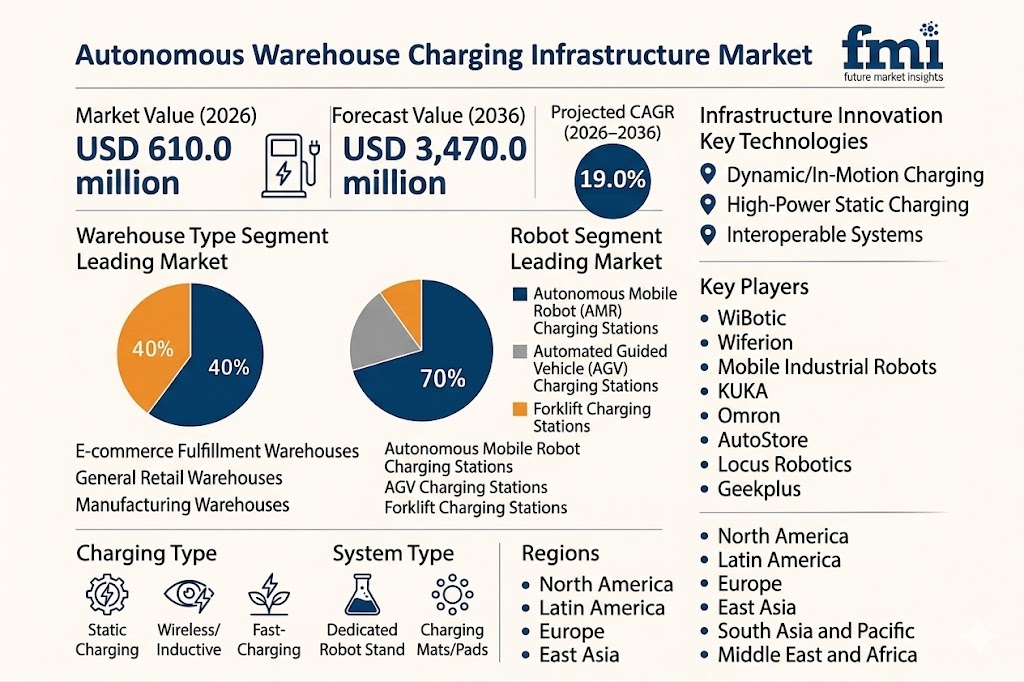
NEWARK, DE / ACCESS Newswire / May 12, 2026 / According to the latest analysis by Future Market Insights (FMI), the global autonomous warehouse charging infrastructure market is entering a decisive commercialization phase as enterprises shift from pilot automation projects toward fully integrated robotic fulfillment ecosystems. Valued at USD 610.0 million in 2026, the market is projected to reach USD 3,470.0 million by 2036, registering a remarkable CAGR of 19.0% during the forecast period.
The industry is evolving from a niche warehouse technology category into a mission-critical operational layer for modern logistics, e-commerce fulfillment, and industrial automation environments. As labor shortages, uptime demands, and sustainability pressures intensify, autonomous charging infrastructure is emerging as the invisible backbone enabling scalable robot deployment.
Get detailed market forecasts, competitive benchmarking, and pricing trends:
https://www.futuremarketinsights.com/reports/sample/rep-gb-33084
Market Snapshot (2026-2036)
Metric
Details
Market Value (2026)
USD 610.0 Million
Forecast Value (2036)
USD 3,470.0 Million
Projected CAGR
19.0%
Leading Robot Segment
Autonomous Mobile Robot Charging Stations
Leading Warehouse Type
E-commerce Fulfillment Warehouses
Dominant Technology Trend
Fleet-Integrated Charging Management
Fastest Growing Market
India (22.0% CAGR)
From Pilot Programs to Operational Necessity
Warehouse operators are no longer experimenting with isolated robotic systems. Instead, companies are deploying interconnected fleets of autonomous mobile robots (AMRs), automated guided vehicles (AGVs), and fulfillment bots that require uninterrupted charging ecosystems capable of supporting 24/7 operations.
"Autonomous charging infrastructure is becoming less about convenience and more about operational continuity," notes an FMI analyst. "Enterprises now demand measurable uptime improvements, fleet-wide visibility, audit-ready energy data, and infrastructure that integrates seamlessly with existing warehouse management systems."
This shift is especially visible in high-volume e-commerce fulfillment centers, which are expected to account for 35.0% of market share in 2026. Growing order volumes, same-day delivery expectations, and rising warehouse complexity are forcing operators to automate both movement and energy management simultaneously.
Autonomous Mobile Robot Charging Stations Dominate Market Demand
Among robot categories, autonomous mobile robot charging stations are projected to capture 46.0% market share in 2026. Their dominance stems from the growing adoption of AMRs across inventory movement, picking, sorting, and packaging applications.
Unlike manual charging processes that introduce workflow interruptions and labor dependency, autonomous charging systems allow robotic fleets to self-manage energy cycles with minimal human intervention. This capability significantly improves operational uptime while reducing congestion in busy fulfillment facilities.
The market's momentum is also being reinforced by fleet-integrated charging management platforms, expected to hold 39.0% share in 2026. These systems enable centralized monitoring of charging behavior, battery health analytics, predictive maintenance scheduling, and intelligent power distribution across robotic fleets.
Smart Energy Orchestration Becomes Competitive Advantage
As warehouses scale automation, charging infrastructure is increasingly viewed as a strategic productivity tool rather than a supporting utility. Advanced energy orchestration platforms now optimize charging windows based on robot workload, traffic density, and operational priorities.
Key technologies driving adoption include:
Docking Chargers: Leading current deployments due to operational simplicity and direct workflow integration.
Wireless Charging Pads: Gaining traction where flexible robot movement and reduced maintenance are priorities.
Opportunity Charging Systems: Supporting short, high-frequency charging intervals that maximize uptime.
Battery Swap Interfaces: Emerging in ultra-high-throughput warehouse environments requiring uninterrupted fleet availability.
The strongest growth opportunities are appearing in facilities where downtime directly impacts revenue generation, service-level agreements, or labor productivity metrics.
Access the Complete Report in PDF Format: https://www.futuremarketinsights.com/reports/brochure/rep-gb-33084
Regional Momentum: India and China Lead High-Growth Expansion
While adoption is accelerating globally, Asia-Pacific markets are emerging as the industry's fastest-growing growth engines.
India: The Fastest-Growing Market
India is forecast to expand at an exceptional 22.0% CAGR through 2036, driven by rapid warehouse modernization, expanding e-commerce penetration, and aggressive logistics infrastructure investments.
Domestic and multinational warehouse operators are increasingly deploying robotic automation to improve scalability while offsetting labor-intensive processes. The rapid expansion of organized retail and third-party logistics providers is further strengthening demand for autonomous charging ecosystems.
China: Large-Scale Industrial Automation Accelerates Adoption
China is expected to register 20.2% CAGR during the forecast period as smart manufacturing initiatives and industrial automation investments continue to accelerate.
Chinese warehouse operators are integrating charging systems directly into broader industrial IoT and AI-powered logistics platforms, creating highly synchronized robotic environments capable of real-time optimization.
United States Maintains Technology Leadership
The United States remains one of the most mature adoption markets and is projected to grow at 18.3% CAGR through 2036. Strong demand is being fueled by:
Large-scale e-commerce operations
Advanced warehouse automation ecosystems
Labor optimization requirements
Sustainability reporting pressures
High operational uptime expectations
Integration Complexity Remains Key Challenge
Despite strong growth potential, the market still faces several operational barriers.
The most significant restraint continues to be integration complexity. Many enterprises already operate sophisticated ERP systems, warehouse management software, robotic fleet platforms, and cloud-based analytics environments. Introducing new charging infrastructure without disrupting workflows remains a major technical challenge.
Additionally, buyers increasingly demand:
Verified performance metrics
Audit-ready operational data
Scalable deployment models
Long-term service support
Interoperability across multiple robot vendors
As a result, suppliers that focus solely on hardware without offering implementation expertise or workflow integration capabilities may struggle to scale customer adoption.
Service-Led Deployment Models Create New Revenue Opportunities
The industry is increasingly shifting toward service-oriented business models that combine charging hardware, monitoring software, analytics, maintenance, and implementation support into integrated offerings.
Buyers now prefer suppliers capable of:
Configuring systems around existing workflows
Providing operational training
Supporting multi-site deployments
Delivering measurable ROI reporting
Ensuring long-term system reliability
This trend is transforming recurring services and software subscriptions into major revenue streams across the autonomous charging infrastructure ecosystem.
Competitive Landscape: Verified Performance Drives Market Competition
Competition within the autonomous warehouse charging infrastructure market is intensifying as vendors compete on integration depth, deployment quality, and operational proof rather than standalone technology claims.
Leading companies operating in the market include:
WiBotic
Wiferion
Mobile Industrial Robots
KUKA
Omron
AutoStore
Locus Robotics
Geekplus
Zebra Technologies
GreyOrange
Industry leaders are investing heavily in:
AI-enabled fleet optimization
Predictive maintenance analytics
Wireless energy transfer systems
Interoperable charging ecosystems
Scalable deployment architectures
The next phase of market leadership will likely belong to suppliers capable of converting pilot projects into enterprise-wide recurring deployment programs.
Buy Report: Unlock 360° insights for strategic decision making and investment planning:
https://www.futuremarketinsights.com/checkout/33084
The Outlook: Infrastructure Becomes the Foundation of Autonomous Warehousing
By 2036, autonomous warehouse charging infrastructure is expected to become an essential operational layer across smart warehouses worldwide. As robotic fleets expand in scale and complexity, charging systems will evolve from passive support tools into intelligent orchestration platforms that directly influence warehouse productivity, sustainability, and profitability.
The industry's future will depend not merely on technological innovation, but on delivering measurable operational outcomes, seamless integration, and scalable deployment models that enable warehouses to automate with confidence.
Related Reports:
Autonomous Industrial Inventory-Tracking Drone Market- https://www.futuremarketinsights.com/reports/autonomous-industrial-inventory-tracking-drone-market
Warehouse Robotics Market- https://www.futuremarketinsights.com/reports/warehouse-robotics-market
Airbag Control Unit Sensor Market- https://www.futuremarketinsights.com/reports/airbag-control-unit-sensor-market
About Future Market Insights (FMI)
Future Market Insights (FMI) is a leading provider of market intelligence and consulting services, serving clients in over 150 countries. Headquartered in Delaware, USA, with a global delivery center in India and offices in the UK and UAE, FMI delivers actionable insights to businesses across industries including automotive, technology, consumer products, manufacturing, energy, and chemicals.
An ESOMAR-certified research organization, FMI provides custom and syndicated market reports and consulting services, supporting both Fortune 1,000 companies and SMEs. Its team of 300+ experienced analysts ensures credible, data-driven insights to help clients navigate global markets and identify growth opportunities.
For Press & Corporate Inquiries
Rahul Singh
AVP - Marketing and Growth Strategy
Future Market Insights, Inc.
+91 8600020075
For Sales - [email protected]
For Media - [email protected]
For web - https://www.futuremarketinsights.com/
For Web - https://www.factmr.com/
SOURCE: Future Market Insights, Inc.