
PhaseV Validates GLP-1 Adverse Event Model on MarketScan and Veradigm Real-World Patient Data
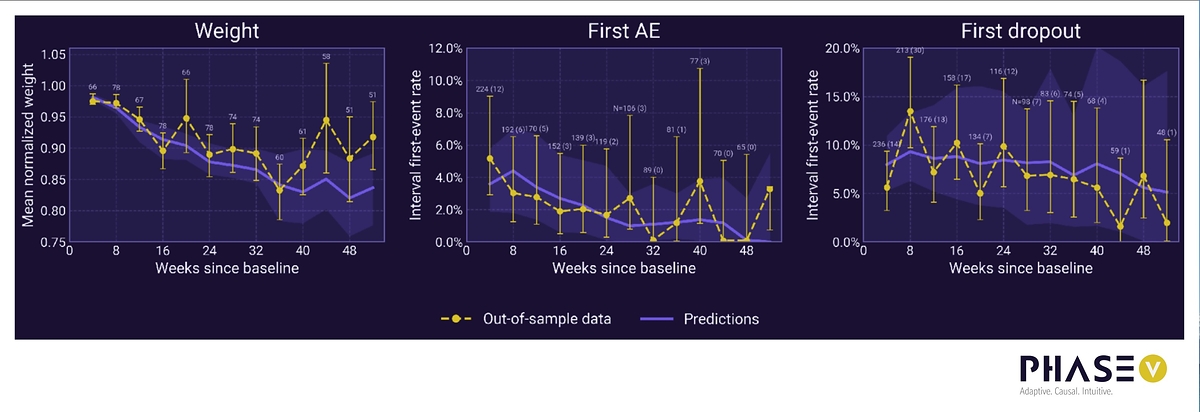 Model calibrated on linked MarketScan claims data and Veradigm EHR data accurately predicted weight, nausea and dropout in patients
BOSTON, Oct. 14, 2026 /PRNewswire/ -- PhaseV, a leader in machine learning for clinical development, today reported validation results for a causal model that predicts adverse events, weight trajectory, and treatment dropout for patients on GLP-1 and related incretin medications. The model was adapted using licensed real-world data, including MarketScan claims data and Veradigm EHR data, and its predictions were tested against real patient data the model had never seen.
Gastrointestinal side effects are the leading reason patients stop taking GLP-1 medications, and dropout during a clinical trial weakens the trial's ability to measure whether the drug works. Tolerability is an important consideration when designing incretin trials, since adverse events can lead to dose changes and treatment discontinuation. Yet relatively few clinical trials directly test how different titration speeds affect adverse-event and dropout rates. Real-world data provides a complementary source of evidence because titration schedules vary considerably across patients in routine care. That variation is not randomized: dose escalation may be slowed in response to an adverse event, for example, while insufficient weight loss may prompt a change in dosing.
With longitudinal data, however, the adverse events, weight trajectories, and dose changes that precede each titration decision can be observed and incorporated into a model. This makes it possible to use real-world variation to estimate how different titration strategies may affect adverse events and dropout, even when randomized comparisons of those strategies are unavailable.
What the model does
The model links dose, weight, adverse events, and dropout as they unfold over time for each patient, rather than treating them as separate, static measurements. This is imperative when learning from real-world data because treatment decisions are themselves influenced by patient outcomes: adverse events may lead to slower dose escalation, while weight response may influence subsequent dosing. The model accounts for these relationships, together with differences in patients' underlying adverse-event risk and adaptation to treatment. Moreover, the model is able to answer "what if" questions, such as how a slower or faster titration schedule would affect a given patient's likelihood of an adverse event or dropout, instead of only describing patterns already in the data.
Validation results
To test the model, PhaseV compared its predictions against real, held-out patient data that was not used in fine-tuning. Across weight, timing of first adverse event, and timing of first dropout, the model's predictions tracked what patients actually experienced.
"Given the impact tolerability has on whether patients stay on treatment, having a model validated against real-world adverse-event and dropout patterns gives sponsors a new way to approach dosing decisions, with evidence rather than inherited assumptions," said Jennifer Meller, MD, MBA, Medical Director, PhaseV.
This model was made possible by PhaseV's recent expansion of its real-world data access, including newly licensed longitudinal data from MarketScan and Veradigm. As PhaseV continues to grow its real-world data foundation, this kind of validated, patient-level evidence becomes available across a widening range of therapeutic areas.
For the first time, titration strategy can be tested against real-world patient evidence before a single patient is dosed in a new trial.
About PhaseV
PhaseV is a Boston-based clinical development technology company that helps biopharma sponsors, CROs, and investors make more informed decisions across trial design, execution, analysis and portfolio strategy. Its agentic platform leverages explainable causal AIs to evaluate development options, improve trial design and execution and identify opportunities to reduce cost, duration and risk.
AI Conductor connects and streamlines the documentation, data standards and statistical programming required throughout clinical development. Together, these capabilities give sponsors an integrated approach spanning trial planning, clinical operations, analysis and regulatory submission.
In four years, PhaseV has supported more than 100 clinical programs for more than 50 global sponsors, including ten of the world's 20 largest pharmaceutical companies. The platform's outputs are grounded in explainable science and a foundation of high-quality, global, pan-therapeutic, multimodal data drawn from PhaseV's proprietary data lake, trusted data partners, and sponsor data. The platform has helped sponsors reduce development costs by up to 50 percent, shorten trial durations by up to 40 percent and improve the probability of success by more than 30 percent.
Learn more at www.PhaseVTrials.com and follow PhaseV on LinkedIn.
Media Contact
Ellie Hanson
FINN Partners for PhaseV
[email protected]
SOURCE PhaseV