
Global Bio-Enzymatic Odor Control Chemicals for Restrooms and Waste Areas Market to Grow at 9.8% CAGR | U.S., India, Brazil Lead Demand | Key Players: Ecolab, Zep, Betco
 Bio-enzymatic odor control market is growing due to demand for long-lasting, source-based odor removal in high-traffic sanitation environments.
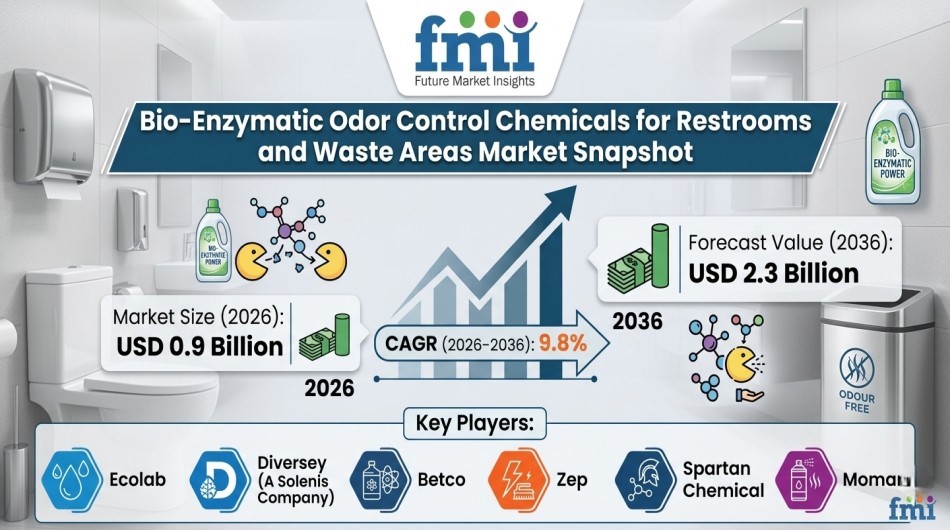
NEWARK, DE / ACCESS Newswire / April 9, 2026 / According to the latest analysis by Future Market Insights, the global bio-enzymatic odor control chemicals for restrooms and waste areas market is witnessing strong expansion, driven by a shift toward performance-based sanitation solutions, increasing demand for source-level odor elimination, and rising adoption of biological cleaning systems. According to market analysis, the market is valued at USD 0.9 billion in 2026 and is projected to reach USD 2.3 billion by 2036, registering a CAGR of 9.8% over the forecast period.
This growth reflects a broader transition away from fragrance masking toward bio-active formulations that deliver sustained odor control through residue digestion, improved drain performance, and longer-lasting effectiveness between cleaning cycles.
Bio-Enzymatic Odor Control Chemicals for Restrooms and Waste Areas Market Snapshot
Market Size (2026): USD 0.9 Billion
Forecast Value (2036): USD 2.3 Billion
CAGR (2026-2036): 9.8%
Leading Product Segment: Enzyme Blends (39% share)
Dominant Form Type: Liquid Concentrates (46% share)
Leading Application: Surface Treatment (31% share)
Top End Use Segment: Institutional Restrooms (34% share)
Leading Sales Channel: Direct Sales (52% share)
Key Players: Ecolab, Diversey (A Solenis Company), Betco, Zep, Spartan Chemical, Momar
Request Sample Report: Get detailed market forecasts, competitive benchmarking, and pricing trends: https://www.futuremarketinsights.com/reports/sample/rep-gb-32614
Growth Dynamics and Demand Drivers
The market is experiencing accelerated demand due to increasing pressure on facility operators to eliminate odors at the source rather than relying on short-term masking solutions. High-traffic environments such as commercial buildings, hospitals, transport hubs, and public facilities are particularly driving adoption due to persistent challenges related to uric acid buildup, organic residue, and waste accumulation.
Bio-enzymatic formulations offer continuous microbial action that remains effective beyond application, reducing repeat odor events, lowering maintenance frequency, and improving consistency across sanitation environments. This shift is redefining buyer expectations in institutional cleaning, where performance is now evaluated based on dwell time, residue digestion, and long-term odor suppression.
Additionally, growth in portable sanitation, waste management, and drain maintenance applications is strengthening the category, as biological systems prove more effective in complex, high-load environments.
Segment Insights
By Product Type
Enzyme blends lead with 39% share due to rapid breakdown of organic matter
Microbial and hybrid blends gaining traction for long-term odor control
Drain digesters expanding in plumbing and waste-treatment applications
By Form
Liquid concentrates dominate (46% share) due to:
Lower transportation costs
Compatibility with dilution systems
Scalable use across multiple facilities
Ready-to-use, foams, and powders serve niche and specialized applications
By Application
Surface treatment leads with 31% share due to high visibility and frequent odor complaints
Drain dosing and waste-room applications growing steadily
Portable toilets and dumpsters driving recurring demand
By End Use
Institutional restrooms dominate (34% share), supported by:
Offices
Hospitals
Hospitality venues
Transport facilities
By Sales Channel
Direct sales lead with 52% share due to:
Need for training and technical support
Integration with dosing systems
Strong supplier-customer relationships
Speak to Analyst: Customize insights for your business strategy: https://www.futuremarketinsights.com/customization-available/rep-gb-32614
Supply Chain and Industry Structure
The supply chain is centered around formulation expertise, biological strain development, and controlled distribution systems. Manufacturers develop enzyme and microbial blends that require careful handling, storage, and application to maintain effectiveness.
Major players maintain strong control over distribution through direct sales and service-linked contracts, ensuring proper training, dosing system integration, and product performance. The market remains fragmented, as odor control spans multiple adjacent sectors including janitorial cleaning, waste management, and drain maintenance.
Pricing and Value Trends
Pricing is shifting toward a value-based model, where buyers evaluate total lifecycle benefits rather than upfront cost. Bio-enzymatic products often reduce long-term expenses by minimizing plumbing maintenance, lowering cleaning frequency, and improving labor efficiency.
Facilities increasingly assess cost per use and operational impact, favoring solutions that deliver consistent performance and reduce recurring odor issues. Premium products are positioned around performance reliability and long-term cost savings, while broader adoption depends on proven efficacy and compatibility with existing cleaning systems.
Competitive Landscape
The market is characterized by strong competition driven by formulation performance, microbial stability, and service integration. Leading players such as Ecolab, Diversey, Betco, Zep, Spartan Chemical, and Momar leverage proprietary bacterial strain libraries and advanced formulation technologies.
Large companies benefit from:
Established distribution networks
Installed dosing infrastructure
Technical service capabilities
Meanwhile, smaller and regional players compete by offering flexible solutions, open-system compatibility, and cost-effective formulations. Competition is increasingly focused on performance validation, training support, and supply chain reliability rather than price alone.
Regional Analysis
Asia Pacific (High Growth Hub)
India (10.8% CAGR): Driven by urbanization and facility management expansion
China (10.2% CAGR): Supported by high-density infrastructure and regulatory pressure
Strong adoption in transport hubs and commercial real estate
North America
United States (8.4% CAGR): Mature but high-value market
Growth driven by healthcare compliance and green building standards
Europe
Germany (7.6% CAGR): Sustainability-focused adoption
United Kingdom (7.3% CAGR): Increasing use in healthcare and institutional facilities
Latin America
Brazil (9.0% CAGR): Climate-driven demand for biological odor control solutions
Other Markets
Japan (6.8% CAGR): Slower growth due to established hygiene systems
Future Outlook and Opportunities
The bio-enzymatic odor control chemicals market is expected to evolve into a critical segment within institutional cleaning and facility management. Growth will be driven by advancements in microbial formulation, automation in dosing systems, and integration with smart monitoring technologies.
Key opportunities include:
Automated drain inoculation systems
Smart sensor-based odor detection and dosing
Hybrid formulations combining immediate and long-term action
Expansion in emerging markets with growing sanitation standards
Companies that can deliver consistent biological performance, ensure compatibility with cleaning protocols, and provide scalable solutions will be best positioned to capture long-term growth.
Buy Full Report: Unlock 360° insights for strategic decision making and investment planning: https://www.futuremarketinsights.com/checkout/32614
Explore More Related Studies Published by FMI Research:
Aircraft Lubricant Market: https://www.futuremarketinsights.com/reports/aircraft-lubricant-market
Polyisocyanurate Insulation Market: https://www.futuremarketinsights.com/reports/polyisocyanurate-insulation-market
Compressor Oil Market: https://www.futuremarketinsights.com/reports/compressor-oil-market
Precious Metal Plating Chemicals Market: https://www.futuremarketinsights.com/reports/precious-metal-plating-chemicals-market
Coil Coatings Market: https://www.futuremarketinsights.com/reports/coil-coatings-market
About Future Market Insights (FMI)
Future Market Insights (FMI) is a leading provider of market intelligence and consulting services, serving clients in over 150 countries. Headquartered in Delaware, USA, with a global delivery center in India and offices in the UK and UAE, FMI delivers actionable insights to businesses across industries including automotive, technology, consumer products, manufacturing, energy, and chemicals.
An ESOMAR-certified research organization, FMI provides custom and syndicated market reports and consulting services, supporting both Fortune 1,000 companies and SMEs. Its team of 300+ experienced analysts ensures credible, data-driven insights to help clients navigate global markets and identify growth opportunities.
For Press & Corporate Inquiries
Rahul Singh
AVP - Marketing and Growth Strategy
Future Market Insights, Inc.
+91 8600020075
For Sales - [email protected]
For Media - [email protected]
For web - https://www.futuremarketinsights.com/
SOURCE: Future Market Insights, Inc.