
Tamarind Gum Derivatives Market to Reach USD 93.22 Million by 2036 | Driven by Clean Label and Natural Thickening Demand as JD Gums & Chemicals, Chemtotal Labs
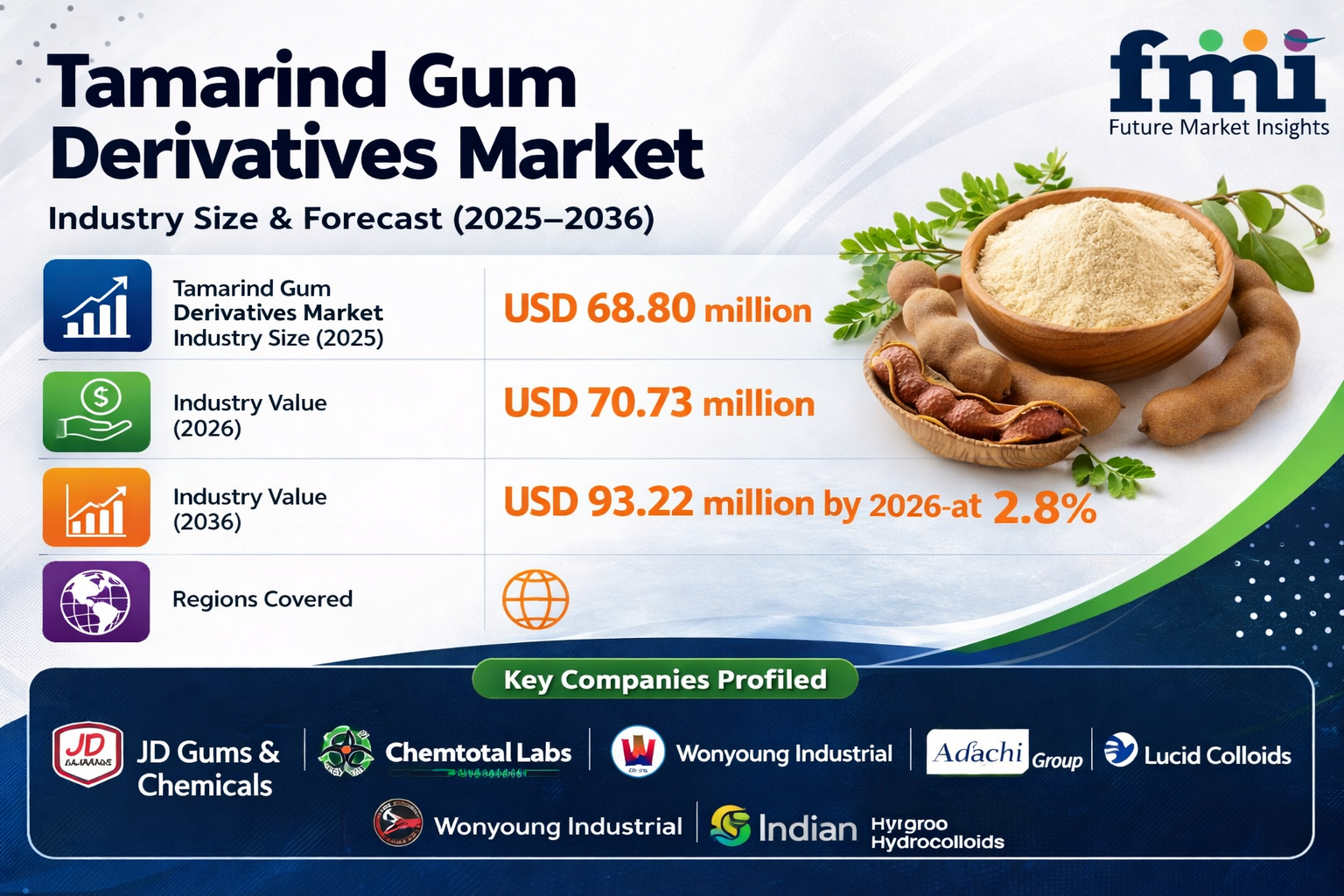 Demand for tamarind gum derivatives is rising steadily, driven by expanding applications in textile processing, food manufacturing, pharmaceuticals, and cosmetics, along with increasing preference for natural hydrocolloid ingredients across industries.
NEWARK, DE / ACCESS Newswire / April 14, 2026 / According to the latest analysis by Future Market Insights, the global Tamarind Gum Derivatives Market is witnessing stable growth, supported by demand for multi-functional plant-based hydrocolloids with thickening, binding, and film-forming properties. The market is estimated to be valued at USD 70.73 million in 2026 and is projected to reach USD 93.22 million by 2036, registering a CAGR of 2.8% over the forecast period.
This growth reflects the increasing adoption of tamarind-derived polysaccharides as cost-effective and biodegradable alternatives to synthetic thickeners, particularly in textile and food applications.
Market Size, Forecast, and Growth Outlook
The tamarind gum derivatives market is expanding steadily across industrial and consumer-facing sectors, supported by its versatility as a hydrocolloid ingredient.
2025 Market Size: USD 68.80 million
2026 Market Size: USD 70.73 million
2036 Forecast Value: USD 93.22 million
CAGR (2026-2036): 2.8%
Absolute Dollar Growth: USD 22.5 million
This growth trajectory highlights the transition from traditional industrial thickening agents to multifunctional natural ingredient systems.
Request Sample Report: Get detailed market forecasts, competitive benchmarking, and pricing trends: https://www.futuremarketinsights.com/reports/sample/rep-gb-27637
Key Demand Drivers
Textile Processing Demand (Primary Driver)
Tamarind gum derivatives are widely used in textile applications for:
Fabric sizing
Printing thickening
Processing stability
Their cost efficiency and biodegradability make them preferred alternatives to synthetic agents.
Growth of Clean-Label Food Ingredients
Food manufacturers are increasingly adopting tamarind gum derivatives as:
Natural thickeners
Stabilizers
Clean-label alternatives to modified starches
This aligns with global trends toward natural and plant-based ingredients.
Expansion in Pharmaceutical and Cosmetic Applications
The derivatives are gaining traction in:
Pharmaceutical binders and excipients
Cosmetic formulations (creams, gels, emulsions)
Film-forming and stabilizing systems
Multi-Functional Hydrocolloid Properties
Tamarind kernel polysaccharides offer:
High viscosity control
Strong binding capacity
Film-forming characteristics
These properties enable cross-industry applications.
Segment Analysis
By Type
Carboxymethyl Tamarind Gum (CMT): 42% share (leading segment)
Hydroxypropyl Tamarind Gum
Oxidized Tamarind Gum
Others
CMT dominates due to:
Superior solubility
Enhanced rheological performance
Wide application compatibility
By Application
Textile: 28% share (dominant segment)
Food
Cosmetics & Personal Care
Pharmaceuticals
Textile remains the backbone, while food and cosmetics provide value-added growth opportunities.
By End Use
Food Manufacturers
Textile Processors
Cosmetic Companies
Pharmaceutical Firms
Specialty Chemical Producers
Food manufacturers lead due to clean-label demand and regulatory compliance needs.
Speak to Analyst: Customize insights for your business strategy - https://www.futuremarketinsights.com/customization-available/rep-gb-27637
Supply Chain Analysis: Who Supplies Whom?
The tamarind gum derivatives market operates through a plant-based raw material processing chain:
Upstream
Tamarind seed sourcing (India, Southeast Asia)
Agricultural cooperatives
Midstream Processing
Kernel processing and extraction
Chemical modification (CMT, HPTG, etc.)
Standardization and formulation
Downstream Distribution
Textile manufacturers
Food processing companies
Cosmetic and pharma firms
Specialty chemical distributors
End Users
Industrial manufacturers
Consumers (via packaged goods, cosmetics, pharma products)
Regional Analysis
China (CAGR: 3.8%) - Leading Market
Strong textile industry
Growing food ingredient demand
Expanding manufacturing base
India (CAGR: 3.5%)
Major raw material supplier
Growing processing capabilities
Cost advantage in production
Germany (CAGR: 3.2%)
Strong food processing sector
High demand for natural ingredients
Brazil (CAGR: 2.9%)
Expanding food and industrial applications
United States (2.7%), United Kingdom (2.4%), Japan (2.1%)
Mature markets with steady demand
Focus on quality, compliance, and clean-label products
Key Trends Shaping the Market
Increasing adoption of natural hydrocolloids
Growth of clean-label food formulations
Expansion in cosmetic and pharma applications
Advances in chemical modification technologies
Integration into automated industrial processing systems
Risks and Challenges
Raw material supply variability (tamarind availability)
Competition from synthetic and alternative hydrocolloids
Price sensitivity in industrial applications
Regulatory compliance requirements
Investment Opportunities
Expansion of tamarind processing and modification facilities
Development of high-performance derivatives (CMT, HPTG)
Growth in food-grade and cosmetic-grade applications
Strategic sourcing partnerships in India and Asia
Innovation in application-specific formulations
Competitive Landscape
The market is moderately fragmented, with competition driven by processing capability, supply chain access, and product functionality.
Leading Companies
JD Gums & Chemicals
Chemtotal Labs
Wonyoung Industrial
Adachi Group
Lucid Colloids
Indian Hydrocolloids
Socius Ingredients
Meckoni Impex
Shree Krishna Industries
Altrafine Gums
Competitive Strategies
Investment in chemical modification technologies
Expansion of global distribution networks
Development of application-specific solutions
Focus on natural and clean-label positioning
Future Outlook
The tamarind gum derivatives market is expected to witness steady, moderate growth through 2036, supported by:
Increasing demand for natural and biodegradable ingredients
Expansion of textile and food processing industries
Growth in multi-functional hydrocolloid applications
Companies that focus on cost efficiency, quality consistency, and application innovation will maintain competitive advantage.
Analyst Perspective
From a strategic standpoint, tamarind gum derivatives represent a stable, multi-industry ingredient category positioned at the intersection of:
Industrial processing efficiency
Clean-label food innovation
Natural ingredient substitution
Suppliers that invest in advanced modification technologies and integrated supply chains will lead long-term growth in this evolving hydrocolloid market.
Full Report: Unlock 360° insights for strategic decision making and investment planning - https://www.futuremarketinsights.com/checkout/27637
Related Reports:
Enzymes Market: https://www.futuremarketinsights.com/reports/enzymes-market
Acidity Regulator Market: https://www.futuremarketinsights.com/reports/acidity-regulator-market
Rosemary & Mixed Tocopherol Antioxidant Blend Market: https://www.futuremarketinsights.com/reports/rosemary-and-mixed-tocopherol-antioxidant-blend-market
PVPP Beer Stabilizer Market: https://www.futuremarketinsights.com/reports/pvpp-beer-stabilizer-market
Oil-in-Water Anionic Emulsifier Market: https://www.futuremarketinsights.com/reports/oil-in-water-anionic-emulsifier-market
About Future Market Insights (FMI)
Future Market Insights (FMI) delivers actionable, decision-maker-focused research backed by real industry inputs and robust forecasting models. The company specializes in:
Pricing analysis and cost benchmarking
Supply chain and procurement intelligence
Technology adoption insights across nutraceuticals and functional ingredients
Customized research for strategic decision-making
FMI combines bottom-up research with expert validation to provide practical, business-ready insights that help companies optimize investments and stay competitive in rapidly evolving markets.
For Press & Corporate Inquiries
Rahul Singh
AVP - Marketing and Growth Strategy
Future Market Insights, Inc.
+91 8600020075
For Sales - [email protected]
For Media - [email protected]
For web - https://www.futuremarketinsights.com/
SOURCE: Future Market Insights, Inc.