
Global Cold-Chain Friendly Post-Harvest Sanitizing Mist Market Outlook 2036: Growth Trends Led by AgroFresh, Ecolab, and Evonik
 Cold-Chain Friendly Post-Harvest Sanitizing Mist Market Gains Momentum with Rising Food Safety Demands
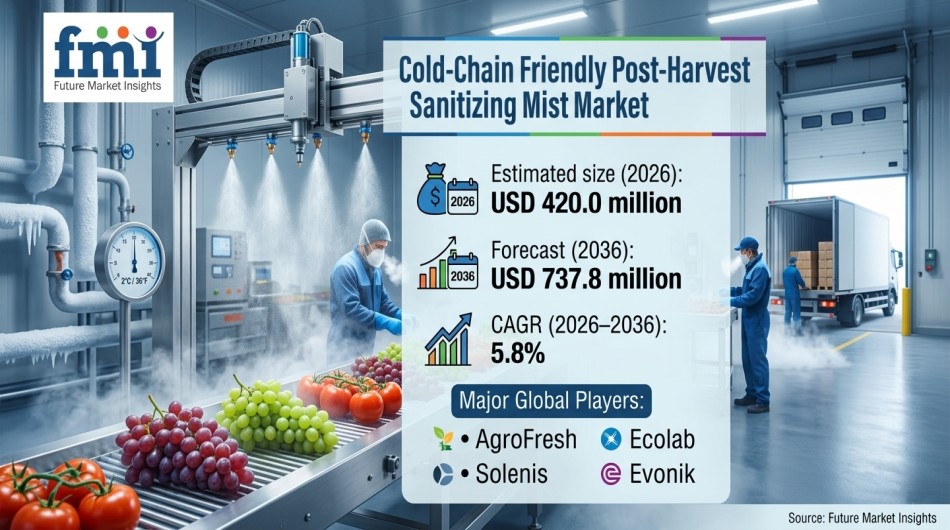
NEWARK, DE / ACCESS Newswire / April 30, 2026 / According to the latest analysis by Future Market Insights, the global cold-chain friendly post-harvest sanitizing mist market is steadily expanding as fresh produce supply chains prioritize low-residue sanitation and contamination control. Valued at USD 397.0 million in 2025, the market is projected to reach USD 420.0 million by 2026 and further grow to USD 737.8 million by 2036, reflecting a CAGR of 5.8%.
This growth is driven by increasing demand for efficient sanitation solutions across cold-chain environments such as packhouses, cold rooms, and produce handling facilities. As food safety regulations tighten and export quality standards rise, sanitizing mist technologies are becoming critical in minimizing microbial contamination without disrupting operations.
Quick Stats for Cold-Chain Friendly Post-Harvest Sanitizing Mist Market
Market size (2025): USD 397.0 million
Estimated size (2026): USD 420.0 million
Forecast (2036): USD 737.8 million
CAGR (2026-2036): 5.8%
Leading chemistry: Peracetic blends (34.0% share in 2026)
Top end-user segment: Packhouses (42.0% share in 2026)
Get detailed market forecasts, competitive benchmarking, and pricing trends: https://www.futuremarketinsights.com/reports/sample/rep-gb-32921
Market Size and Growth Outlook
The market is expected to witness moderate but stable growth over the next decade, reaching USD 737.8 million by 2036. Unlike high-volume sanitation products, growth in this segment is driven by specialized, process-integrated applications in cold-chain handling environments.
Sanitizing mist solutions are gaining traction where contamination risks directly impact shelf life, export acceptance, and operational efficiency, positioning the market as a niche but strategically important segment in post-harvest management.
Growth Drivers: Hygiene Efficiency Meets Operational Practicality
Demand is fueled by the need for sanitation methods that balance microbial control with minimal operational disruption:
Low-residue sanitation demand: Fresh produce handlers prefer solutions that do not leave visible residues or affect crop quality.
Cold-chain compatibility: Mist systems work effectively in enclosed cold environments without requiring heavy water use.
Export quality standards: Increasing rejection risks in global trade are pushing investments in advanced sanitation.
Water management needs: Reduced water usage compared to traditional wash systems supports sustainability goals.
Challenges: Selective Adoption and Process Constraints
Despite growing adoption, several barriers remain:
Crop sensitivity: Not all produce types respond well to mist-based sanitation.
Operational control requirements: Effective use requires controlled environments and precise dosing.
Preference for simpler methods: Smaller facilities often rely on conventional sanitation formats.
Limited pricing power: Cost pressures in commodity produce handling restrict premium adoption.
Opportunities: Expanding Role in Cold-Chain Infrastructure
New growth avenues are emerging as cold-chain systems evolve globally:
Export-driven fruit programs: High-value produce increases the need for contamination control.
Integrated hygiene systems: Facilities are moving toward comprehensive sanitation frameworks.
Closed-space sanitation: Cold rooms and storage areas benefit from mist-based coverage.
Water-conscious operations: Facilities aiming to reduce water usage are adopting mist technologies.
Customize insights for your business strategy@ https://www.futuremarketinsights.com/customization-available/rep-gb-32921
Segmentation Insights
By Chemistry
Peracetic blends dominate with a 34.0% share in 2026, driven by their strong antimicrobial performance and low-residue profile. Chlorine dioxide and hydrogen peroxide complement sanitation programs where specific crop or process requirements differ.
By Application Stage
Packing lines (31.0% share): High contamination risk due to frequent surface contact
Cold rooms & bin sanitation: Consistent demand for maintaining storage hygiene
By End User
Packhouses (42.0% share): Centralized sanitation and quality control operations
Exporters & cold stores: Increasing investment driven by rejection risks and quality demands
Regional Dynamics: Emerging Markets Drive Growth
Growth patterns reflect expansion in cold-chain infrastructure and export activity:
China (7.1% CAGR): Rapid cold-chain expansion and large-scale produce handling
India (6.9% CAGR): Improving food safety practices and organized supply chains
Brazil (6.4%) & Mexico (6.2%): Export-driven adoption in fruit and vegetable sectors
Spain & Netherlands: Growth driven by process optimization in mature markets
United States (5.4% CAGR): Demand led by upgrades and replacement cycles
Emerging economies are witnessing faster adoption due to infrastructure development, while mature markets focus on efficiency improvements.
Competitive Landscape: Fragmented but Expertise-Driven
The market remains fragmented, with competition spanning multiple segments:
Produce-focused post-harvest specialists
Food sanitation and antimicrobial solution providers
Oxidizing chemistry manufacturers
Key players include:
AgroFresh
BioSafe Systems
Solenis
Ecolab
Enviro Tech Chemical Services
Evonik
UPL
Competitive advantage depends less on product pricing and more on technical support, produce compatibility, and integration into existing cold-chain processes.
Strategic Implications for Decision-Makers
Targeted adoption: Best suited for operations requiring low-residue, enclosed-space sanitation
Process integration: Success depends on compatibility with existing workflows
Export alignment: Strong ROI in export-oriented produce handling
Supplier selection: Technical support and dosing guidance are critical differentiators
Future Outlook: From Niche Solution to Process Standard
The cold-chain friendly post-harvest sanitizing mist market is evolving into a critical component of modern produce handling systems. While adoption remains selective, increasing focus on food safety, water efficiency, and export quality is expected to drive steady growth.
Future expansion will depend on improving ease of application, ensuring crop compatibility, and integrating sanitation into broader cold-chain management strategies.
Executive Takeaways
The market is growing steadily, driven by food safety and cold-chain efficiency needs
Packhouses and peracetic blends dominate demand and application
Emerging markets are key growth engines due to expanding infrastructure
Adoption is selective, shaped by crop sensitivity and operational complexity
Long-term opportunity lies in export-driven produce systems and integrated hygiene solutions
For industry stakeholders, the focus is shifting from basic sanitation toward precision-driven, process-compatible solutions that enhance both product quality and operational efficiency.
Unlock 360° insights for strategic decision making and investment planning@ https://www.futuremarketinsights.com/checkout/32921
Explore More Related Studies Published by FMI Research:
Polymer Processing Aid (PPA) Market: https://www.futuremarketinsights.com/reports/polymer-processing-aid-ppa-market
Oilfield Stimulation Chemicals Market: https://www.futuremarketinsights.com/reports/oilfield-stimulation-chemicals-market
Food And Beverage Chemicals Market: https://www.futuremarketinsights.com/reports/food-and-beverage-chemicals-market
Boiler Water Treatment Chemicals Market: https://www.futuremarketinsights.com/reports/boiler-water-treatment-chemicals-market
Alunite Market: https://www.futuremarketinsights.com/reports/alunite-market
About Future Market Insights (FMI)
Future Market Insights (FMI) is a leading provider of market intelligence and consulting services, serving clients in over 150 countries. Headquartered in Delaware, USA, with a global delivery center in India and offices in the UK and UAE, FMI delivers actionable insights to businesses across industries including automotive, technology, consumer products, manufacturing, energy, and chemicals.
An ESOMAR-certified research organization, FMI provides custom and syndicated market reports and consulting services, supporting both Fortune 1,000 companies and SMEs. Its team of 300+ experienced analysts ensures credible, data-driven insights to help clients navigate global markets and identify growth opportunities.
For Press & Corporate Inquiries
Rahul Singh
AVP - Marketing and Growth Strategy
Future Market Insights, Inc.
+91 8600020075
For Sales - [email protected]
For Media - [email protected]
For web - https://www.futuremarketinsights.com/
SOURCE: Future Market Insights, Inc.