
Nanobot Targeted Drug Delivery Implants Market Forecast 2026-2036: Global Market to Reach USD 343.8 Million by 2036 at 13.60% CAGR
 Nanobot Targeted Drug Delivery Implants Gain Clinical Momentum as Precision Oncology and Localized Therapeutics Drive Next-Gen Implant Adoption
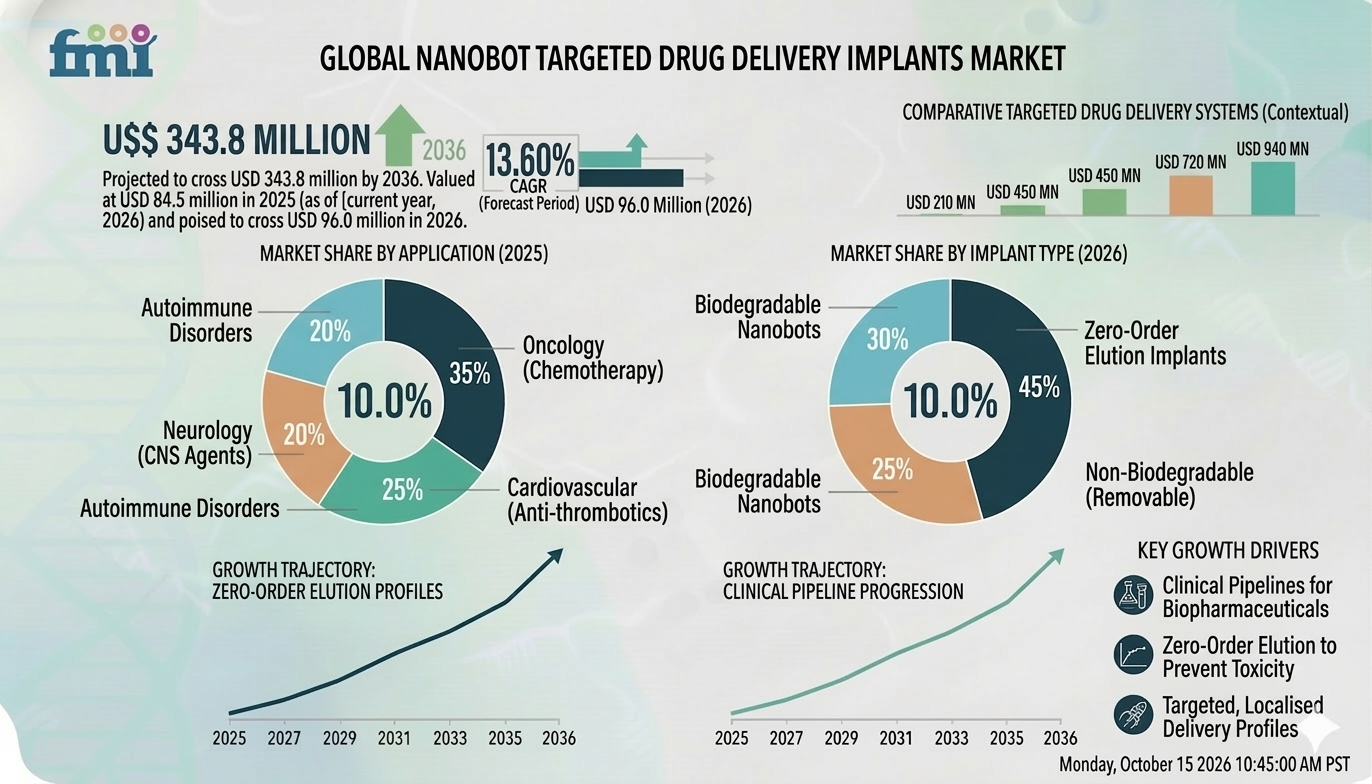
NEWARK, DE / ACCESS Newswire / March 20, 2026 / The global nanobot targeted drug delivery implants market is entering a high-growth phase as healthcare systems transition from systemic drug administration toward localized, precision-based therapeutic delivery. Valued at USD 96.0 million in 2026, the market is projected to reach USD 343.8 million by 2036, expanding at a CAGR of 13.60% during the forecast period. According to Future Market Insights (FMI), the rising need to mitigate systemic toxicity and improve therapeutic outcomes is accelerating the adoption of implantable nanomedicine platforms across oncology, neurology, and chronic disease management.
Discover Growth Opportunities in the Market - Get Your Sample Report Now: https://www.futuremarketinsights.com/reports/sample/rep-gb-32398
Nanobot Targeted Drug Delivery Implants Market Metrics (2026-2036)
Market Indicator
Value
Market Size (2026)
USD 96.0 Million
Market Value (2036)
USD 343.8 Million
Global CAGR
13.60%
Leading Technology
Nanofluidic Membrane Implants (31.0% Share)
Dominant Material
Biodegradable Polymer Implants (36.0% Share)
Leading Application
Oncology (42.0% Share)
Key End Users
Specialty Hospitals & Cancer Centers (39.0% Share)
Precision Medicine Shift: From Systemic Infusion to Localized Nanomedicine Implants
The nanobot targeted drug delivery implants market is undergoing a structural transformation as clinicians shift away from traditional systemic therapies toward localized, controlled-release solutions.
Unlike intravenous or oral drug delivery, these implants enable:
Continuous, zero-order drug release
High localized drug concentration at target sites
Elimination of patient adherence challenges
Reduced systemic toxicity and side effects
This shift is particularly critical in oncology and neurology, where maintaining therapeutic concentration at tumor or neural sites without damaging healthy tissues is essential.
FMI analysis indicates that localized implant-based drug delivery significantly reduces relapse rates and improves clinical trial success for narrow-therapeutic-index drugs.
Technology Insights: Nanofluidic Membrane Implants Enable Controlled Drug Release
Nanofluidic Membrane Implants (31.0% Share)
Nanofluidic membrane implants dominate the technology landscape due to their ability to precisely control molecular diffusion through engineered nanoscale channels. This enables:
Predictable zero-order release kinetics
Elimination of burst-release effects
Enhanced stability of potent biologics
These systems shift the development focus from drug formulation to device engineering, ensuring consistent therapeutic delivery regardless of physiological variability.
Material Innovation: Biodegradable Polymers Drive Clinical Adoption
Biodegradable Polymer Implants (36.0% Share)
Biodegradable polymer implants lead the market as healthcare providers increasingly demand solutions that eliminate the need for secondary surgical removal. Key advantages include:
Tunable degradation aligned with drug release duration
Reduced risk of chronic foreign-body reactions
Compatibility with long-term treatment protocols
These materials enable full physiological absorption, making them ideal for chronic disease and oncology applications.
Application Leadership: Oncology Drives Market Demand
Oncology (42.0% Share)
Oncology remains the dominant application segment due to the urgent need for localized, high-intensity drug delivery. Implantable systems allow:
Continuous treatment at tumor resection margins
Bypassing systemic circulation barriers
Combination therapy integration with immunotherapy
This localized approach significantly enhances treatment efficacy while minimizing systemic toxicity.
End-User Insights: Specialty Hospitals Lead Adoption
Specialty Hospitals & Cancer Centers (39.0% Share)
Specialized healthcare facilities dominate adoption due to their advanced infrastructure, including:
Imaging-guided surgical systems
Interventional oncology expertise
Access to clinical trial pipelines
These institutions are at the forefront of integrating nanomedicine implants into standard treatment protocols.
Regional Outlook: Asia Pacific Emerges as High-Growth Hub
China (15.8% CAGR): Rapid deployment of nanomedicine implants driven by strong government funding and advanced research hospitals
India (15.1% CAGR): Expansion of corporate hospital networks supporting large-scale clinical adoption
South Korea (14.0% CAGR): Leadership in nanofabrication and precision engineering
United States (13.2% CAGR): Growth moderated by complex regulatory pathways but supported by strong clinical infrastructure
Germany (12.6% CAGR) & UK (12.2% CAGR): Adoption driven by stringent healthcare outcomes and reimbursement frameworks
Asia Pacific leads growth as healthcare systems bypass legacy infusion infrastructure and directly adopt advanced implantable technologies.
Key Growth Drivers: Toxicity Reduction, Adherence Elimination, and Clinical Efficiency
The market expansion is supported by several structural drivers:
Systemic Toxicity Challenges: Increasing failure rates of biologics due to off-target effects
Patient Non-Adherence: Demand for long-acting, implant-based therapies
Outpatient Care Transition: Shift toward minimally invasive, ambulatory procedures
Precision Oncology Growth: Rising need for localized tumor-targeted therapies
Competitive Landscape: Innovation-Led, Platform-Centric Market
The nanobot targeted drug delivery implants market is technology-driven, with companies focusing on proprietary implant platforms and material science innovation.
Key players include:
Vivani Medical, Inc.
Delpor, Inc.
DelSiTech Ltd.
Daré Bioscience, Inc.
Medtronic plc
Renishaw plc
Flowonix Medical, Inc.
Market competition centers on:
Mechanical reliability of implant systems
Biocompatibility and degradation performance
Integration into biopharma clinical pipelines
Exclusive licensing partnerships
Outlook: Localized Drug Delivery to Redefine Therapeutic Standards
Looking ahead to 2036, nanobot targeted drug delivery implants are expected to redefine the pharmaceutical and medical device landscape by enabling:
Fully bioresorbable implant systems
Multi-phase and combination drug delivery architectures
Integration with immunotherapy and metabolic treatments
Expansion into CNS disorders and obesity management
As healthcare systems prioritize precision, safety, and efficiency, implantable nanomedicine platforms are poised to become a cornerstone of next-generation therapeutic delivery.
For an in-depth analysis of these trends and to access the complete Nanobot Targeted Drug Delivery Implants Market Forecast through 2036, visit: https://www.futuremarketinsights.com/reports/nanobot-targeted-drug-delivery-implants-market
Related Reports:
Drug Delivery Technology Market: https://www.futuremarketinsights.com/reports/drug-delivery-technology-market
Novel Drug Delivery Systems In Cancer Therapy Market: https://www.futuremarketinsights.com/reports/novel-drug-delivery-systems-in-cancer-therapy-market
Ocular Drug Delivery System Market: https://www.futuremarketinsights.com/reports/ocular-drug-delivery-system-market
Connected Drug Delivery Devices Market: https://www.futuremarketinsights.com/reports/connected-drug-delivery-devices-market
Injectable Drug Delivery Market: https://www.futuremarketinsights.com/reports/injectable-drug-delivery-market
About Future Market Insights (FMI)
Future Market Insights (FMI) is a leading provider of market intelligence and consulting services, serving clients in over 150 countries. Headquartered in Delaware, USA, with a global delivery center in India and offices in the UK and UAE, FMI delivers actionable insights to businesses across industries including automotive, technology, consumer products, manufacturing, energy, and chemicals.
An ESOMAR-certified research organization, FMI provides custom and syndicated market reports and consulting services, supporting both Fortune 1,000 companies and SMEs. Its team of 300+ experienced analysts ensures credible, data-driven insights to help clients navigate global markets and identify growth opportunities.
For Press & Corporate Inquiries:
Rahul Singh
AVP - Marketing and Growth Strategy
Future Market Insights, Inc.
+91 8600020075
For Sales - [email protected]
For Media - [email protected]
For web - https://www.futuremarketinsights.com
SOURCE: Future Market Insights, Inc.