
Waterborne Polyurethane Dispersions for Automotive Synthetic Leather Market to Reach USD 899.8M Globally by 2036 | India, China Lead Growth | Covestro, Lubrizol, BASF Dominate
 Market grows with shift to low-emission materials, driven by EV demand, sustainability, and need for durable, high-performance synthetic leather interiors.
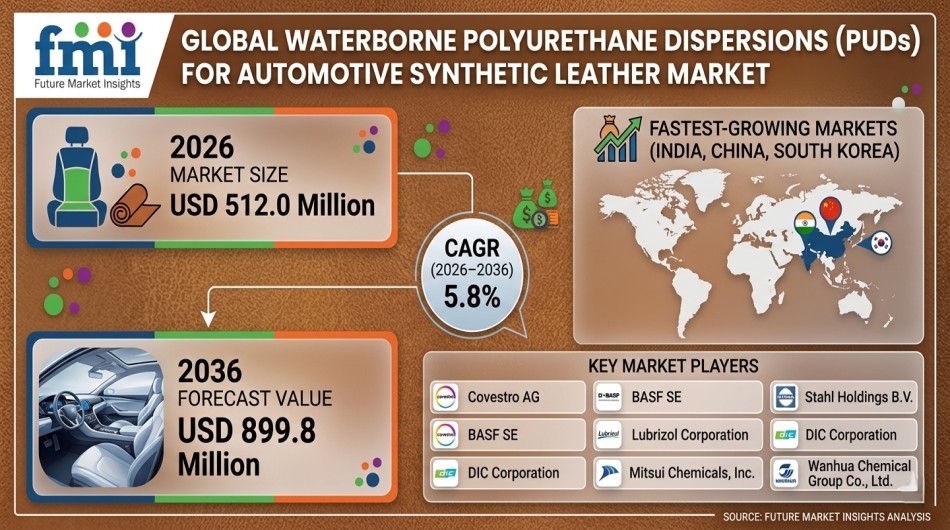
NEWARK, DE / ACCESS Newswire / April 22, 2026 / According to the latest analysis by Future Market Insights, the global waterborne polyurethane dispersions (PUDs) for automotive synthetic leather market is experiencing steady expansion, supported by tightening emission regulations, increasing vehicle interior premiumization, and the automotive sector's transition toward sustainable material systems. The market is valued at USD 512.0 million in 2026 and is projected to reach USD 899.8 million by 2036, registering a CAGR of 5.8% over the forecast period.
This growth reflects a structural shift away from solvent-based coatings toward low-VOC, waterborne alternatives that enhance cabin air quality and regulatory compliance.
Market Snapshot: Waterborne Polyurethane Dispersions for Automotive Synthetic Leather Market
Market Size (2026): USD 512.0 Million
Forecast Value (2036): USD 899.8 Million
CAGR (2026-2036): 5.8%
Leading Chemistry Segment: Anionic (54.0% share)
Dominant Resin Type: Polyester (46.0%)
Top Layer Segment: Surface Coat (41.0%)
Primary Vehicle Segment: Passenger Cars (78.0%)
Leading Sales Channel: OEM Trim (72.0%)
Fastest-Growing Markets: India, China, South Korea
Key Players: Covestro AG, BASF SE, Stahl Holdings B.V., Lubrizol Corporation, DIC Corporation, Mitsui Chemicals, Inc., Wanhua Chemical Group Co., Ltd.
Get detailed market forecasts, competitive benchmarking, and pricing trends: https://www.futuremarketinsights.com/reports/sample/rep-gb-32767
Growth Dynamics and Demand Drivers
The market is gaining strong momentum as automotive manufacturers accelerate the shift toward low-emission interior materials. Increasingly stringent regulations on volatile organic compound (VOC) emissions are compelling OEMs and Tier-1 suppliers to replace solvent-based polyurethane systems with waterborne dispersions.
In addition, the rapid rise of electric vehicles (EVs) is amplifying demand for high-performance synthetic leather materials that support improved cabin air quality, lightweight construction, and premium tactile experience. Waterborne PUDs offer advantages such as reduced environmental impact, better compliance with indoor air quality standards, and compatibility with modern sustainability goals.
Another key driver is the growing use of synthetic leather across seats, dashboards, door panels, and armrests. Automakers are balancing cost efficiency with luxury aesthetics, making waterborne coatings a preferred solution for delivering durability, flexibility, and consistent surface finish.
Segment Insights
By Chemistry
Anionic segment leads (54.0% share) due to:
Superior emulsion stability under high-speed coating
Strong adhesion performance across substrates
Compatibility with water-based primer systems
By Resin Type
Polyester dominates (46.0% share) driven by:
High tensile strength for seating applications
Cost efficiency for large-scale automotive programs
Reliable curing and processing behavior
By Layer Type
Surface coat leads (41.0%) as it:
Controls gloss and tactile feel
Enhances scratch resistance
Enables compliance with VOC emission norms
By Vehicle Type
Passenger cars dominate (78.0%) due to:
Rising interior premiumization
Increased demand for comfort and acoustic performance
Expansion of EV platforms
By Sales Channel
OEM trim leads (72.0%) driven by:
Long validation cycles and supplier lock-in
Integration into large-scale vehicle platforms
High entry barriers for aftermarket players
Supply Chain and Industry Structure
The supply chain is highly specialized and closely aligned with automotive manufacturing ecosystems. Chemical producers develop advanced dispersion formulations, which are then supplied to Tier-1 interior manufacturers responsible for coating and fabric processing.
OEM approval processes play a critical role, often requiring extensive multi-year validation cycles. Once approved, suppliers benefit from long-term contracts and predictable demand across vehicle platforms. Additionally, localized production and just-in-time delivery models are becoming increasingly important to maintain efficiency across global automotive supply chains.
Pricing and Value Trends
Pricing in the market is gradually shifting toward a performance-based and lifecycle value model. While waterborne PUDs may carry slightly higher upfront costs compared to solvent-based systems, they offer long-term benefits such as:
Lower environmental compliance costs
Reduced health and safety risks
Improved durability and product lifespan
Automotive manufacturers are prioritizing total cost of ownership, making high-performance, low-emission materials more commercially attractive.
Competitive Landscape
The market is characterized by a concentrated group of global chemical companies with strong R&D capabilities and established OEM relationships. Companies such as Covestro AG, BASF SE, and Lubrizol Corporation dominate through advanced formulation technologies and extensive validation infrastructure.
Competition is primarily based on:
Long-term adhesion and hydrolysis resistance
Process compatibility with existing coating lines
Ability to meet stringent automotive standards
Emerging players face high entry barriers due to the need for extensive testing, certification, and alignment with OEM specifications.
Customize insights for your business strategy@ https://www.futuremarketinsights.com/customization-available/rep-gb-32767
Regional Analysis
Asia Pacific (High Growth Hub)
India (7.3% CAGR): Driven by rapid vehicle production expansion and stricter emission norms
China (6.8% CAGR): Strong EV growth and premium interior demand
South Korea (5.9% CAGR): Focus on durability and export-quality materials
North America
United States (5.1% CAGR): Growth driven by EV adoption and strict environmental standards
Strong demand for durable, low-emission interior materials
Europe
Germany (4.5% CAGR): Sustainability regulations shaping material innovation
Emphasis on circular economy and eco-friendly coatings
Latin America
Mexico (5.6% CAGR): Expanding automotive manufacturing base and regional supply chain integration
Other Markets
Japan (4.8% CAGR): Mature market with strong focus on quality and long-term reliability
Future Outlook and Opportunities
The market is expected to witness sustained growth as automotive manufacturers continue transitioning toward sustainable and high-performance interior materials. Key opportunities include:
Development of high-solid, fast-curing formulations
Integration with microfiber synthetic leather technologies
Expansion in EV-specific interior applications
Investment in localized production and advanced coating infrastructure
Companies that can balance performance, cost efficiency, and regulatory compliance will be best positioned to capture long-term growth.
Conclusion
The shift toward waterborne polyurethane dispersions for automotive synthetic leather represents a fundamental transformation in automotive material engineering. As environmental regulations tighten and consumer expectations for premium, sustainable interiors rise, waterborne systems are set to become a standard across global vehicle platforms. With steady growth projected through 2036, the market offers strong opportunities for innovation, scalability, and long-term value creation.
Unlock 360° insights for strategic decision making and investment planning@ https://www.futuremarketinsights.com/checkout/32767
Explore More Related Studies Published by FMI Research:
Biomass Gasification Market: https://www.futuremarketinsights.com/reports/biomass-gasification-market
Entrance Matting Market: https://www.futuremarketinsights.com/reports/entrance-matting-market
Latin America Joint Compound Industry Analysis: https://www.futuremarketinsights.com/reports/joint-compound-industry-analysis-in-latin-america
Activated Carbon Fiber Market: https://www.futuremarketinsights.com/reports/activated-carbon-fiber-market
Tow Prepreg Market: https://www.futuremarketinsights.com/reports/tow-prepreg-market
About Future Market Insights (FMI)
Future Market Insights (FMI) is a leading provider of market intelligence and consulting services, serving clients in over 150 countries. Headquartered in Delaware, USA, with a global delivery center in India and offices in the UK and UAE, FMI delivers actionable insights to businesses across industries including automotive, technology, consumer products, manufacturing, energy, and chemicals.
An ESOMAR-certified research organization, FMI provides custom and syndicated market reports and consulting services, supporting both Fortune 1,000 companies and SMEs. Its team of 300+ experienced analysts ensures credible, data-driven insights to help clients navigate global markets and identify growth opportunities.
For Press & Corporate Inquiries
Rahul Singh
AVP - Marketing and Growth Strategy
Future Market Insights, Inc.
+91 8600020075
For Sales - [email protected]
For Media - [email protected]
For web - https://www.futuremarketinsights.com/
SOURCE: Future Market Insights, Inc.