
Upcycled Food Waste Protein Snacks Market to Cross USD 4.3 Billion by 2036 as Functional Integrity Surpasses Sustainability Narrative
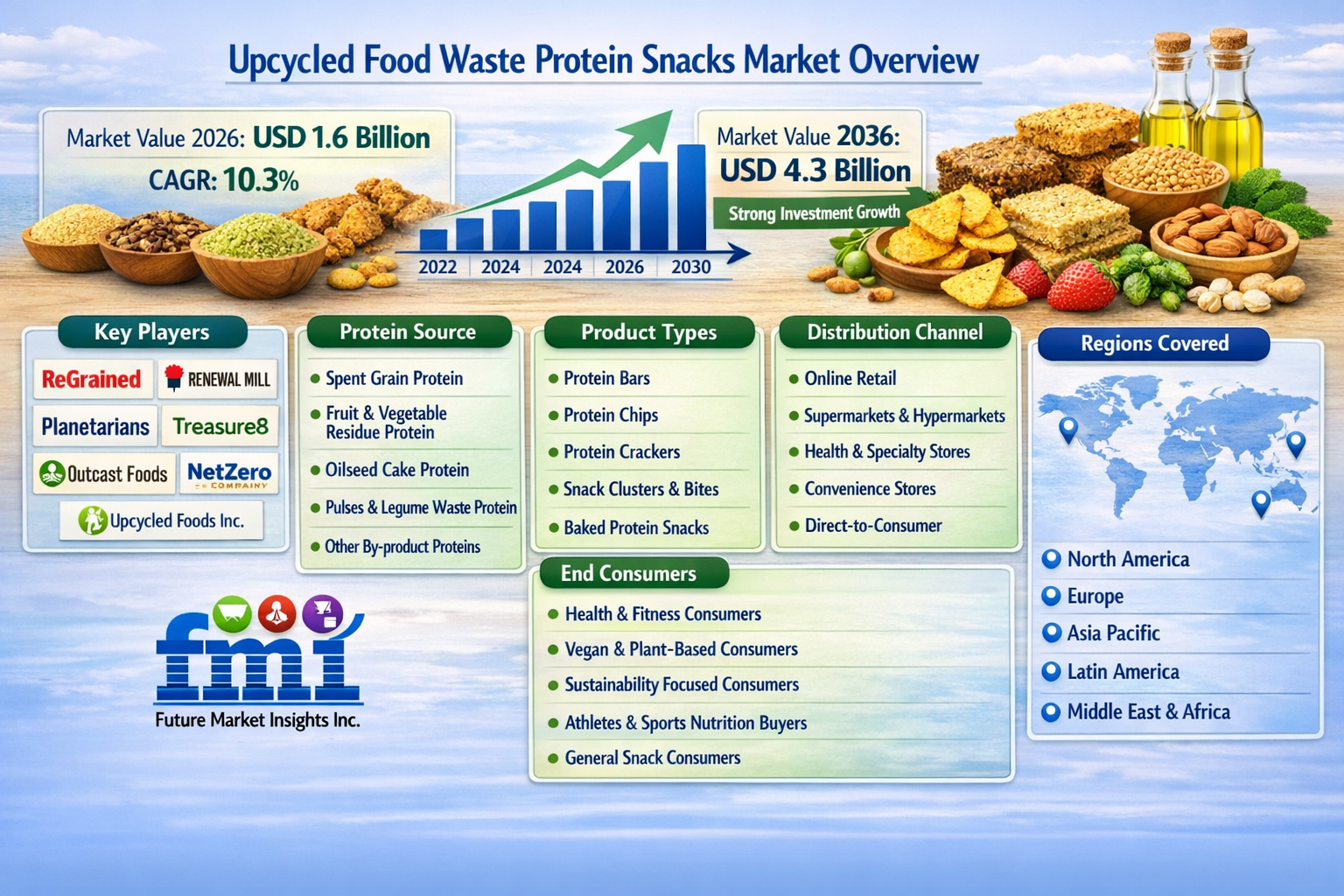 Upcycled protein snacks are transitioning from experimental marketing to strategic core ingredients, leveraging superior moisture-retention to solve shelf-hardening in extruded formats.
NEWARK, DE / ACCESS Newswire / March 23, 2026 / The global Upcycled Food Waste Protein Snacks market is undergoing a technical revolution, moving beyond "green" positioning toward functional dominance. Valued at USD 1.4 billion in 2025, the sector is poised to reach USD 1.6 billion in 2026. Driven by a 10.3% CAGR, the market is projected to hit USD 4.3 billion by 2036, according to Future Market Insights (FMI).
The industry is seeing a pivot where procurement leaders recognize upcycled proteins-such as spent grain and defatted oilseed cakes-as essential binders. These ingredients offer a strategic hedge against the price volatility of conventional soy and whey isolates while providing superior hydrocolloid properties that extend product shelf life.
Get Access to the Full Report Sample: https://www.futuremarketinsights.com/reports/sample/rep-gb-32393
"Category buyers often assume the value of upcycled fractions is purely for carbon accounting," says Nandini Roy Choudhury, Principal Analyst at FMI. "In reality, the technical value lies in moisture retention. Spent grain isolates solve the notorious shelf-hardening problem in extruded bars. Companies formulating for the functional advantage will outpace those focusing solely on the sustainability narrative."
Key Market Insights & Segment Performance
The market is increasingly defined by "functional parity," where upcycled ingredients must match the sensory and nutritional integrity of virgin isolates to succeed.
Spent Grain Protein (32.5% Market Share): Dominates due to high supply density from the global brewing industry and established dewatering infrastructure.
Protein Bars (36.2% Market Share): The leading format, as cold extrusion processes benefit directly from the superior water-binding capacity of upcycled fractions.
Health & Fitness Consumers (41.6% Market Share): This segment drives early adoption, prioritizing macronutrient density and amino acid profiles over ingredient familiarity.
Regional Velocity: India and North America Lead Growth
While North America benefits from intense venture capital investment in extraction tech, India's massive agricultural residue stream is driving the world's highest growth rate.
Country
Projected CAGR (2026-2036)
Strategic Driver
India
11.4%
Massive agricultural residues meeting a formalizing clean-label snack segment.
USA
10.7%
Concentrated craft brewery networks providing dense feedstock for upcycling.
Canada
10.2%
Mature infrastructure for cold-press extraction of pulse and legume residues.
United Kingdom
9.9%
Strict retailer mandates penalizing brands that lack circular economy credentials.
Germany
9.6%
Advanced enzymatic treatments neutralizing bitter notes in spent grains.
Strategic Takeaways for Stakeholders
Formulation Mastery: Directors must prioritize proprietary milling and enzymatic technologies to ensure sensory neutrality across variable waste batches.
Supply Chain Insulation: Procurement leads should secure long-term offtake agreements with regional processors before multinational conglomerates monopolize the supply of high-density residues.
Dynamic Manufacturing: Contract manufacturers need to integrate adaptive recipe software to manage the fluctuating nutritional profiles of seasonal agricultural byproducts.
Key Companies Profiled: Givaudan, dsm-firmenich, International Flavors & Fragrances Inc., Symrise AG, Kerry Group plc, T. Hasegawa Co., Ltd., Sensient Technologies Corporation.
Competitive Landscape
The upcycled snack sector is characterized by a highly concentrated supply integration layer, even though the consumer-facing brand landscape remains deeply fragmented. Leading companies such as ReGrained and Renewal Mill derive their competitive advantage not from aggressive marketing strategies, but from their control over proprietary dewatering and milling technologies that stabilize highly variable waste streams.
Procurement directors evaluating upcycled protein snack suppliers prioritize consistency above all else, focusing on the ability to deliver uniform functional specifications across batches. This requirement significantly influences factors such as okara utilization and market share. Vendors without access to specialized homogenization equipment are unable to ensure the sensory neutrality necessary for continuous extrusion processes, effectively disqualifying them from tier-one supplier consideration.
Established upcycled snack manufacturers further strengthen their position through exclusive, long-term offtake agreements with regional breweries and agricultural processors, securing a steady supply of consistent spent grain flour. These tightly controlled supply chains create substantial barriers to entry, as handling wet and perishable residues requires processing facilities to be located in close proximity to the source.
This geographic dependency introduces unique investment dynamics within the upcycled food ecosystem. New entrants attempting to replicate such models must invest heavily in building localized processing infrastructure, resulting in significant upfront capital requirements. Ultimately, the successful integration of sustainable food ingredients depends less on end-product formulation capabilities and more on the ability to establish and maintain a robust, localized supply network.
Unlock In-Depth Upcycled Food Waste Protein Snacks Market Intelligence - Access the Full Report Now: https://www.futuremarketinsights.com/reports/upcycled-food-waste-protein-snacks-market
Why FMI: https://www.futuremarketinsights.com/why-fmi
𝗛𝗮𝘃𝗲 𝗮 𝗟𝗼𝗼𝗸 𝗮𝘁 𝗥𝗲𝗹𝗮𝘁𝗲𝗱 𝗥𝗲𝘀𝗲𝗮𝗿𝗰𝗵 𝗥𝗲𝗽𝗼𝗿𝘁𝘀 𝗼𝗻 𝗙𝗼𝗼𝗱 & 𝗕𝗲𝘃𝗲𝗿𝗮𝗴𝗲 𝗗𝗼𝗺𝗮𝗶𝗻:
Malted Milk Powder Market: https://www.futuremarketinsights.com/reports/malted-milk-powder-market
Chitosan Oligosaccharides Market: https://www.futuremarketinsights.com/reports/chitosan-oligosaccharides-market
Flax Milk Market: https://www.futuremarketinsights.com/reports/flax-milk-market
Rare Sugar Market: https://www.futuremarketinsights.com/reports/rare-sugar-market
Mezcal Market: https://www.futuremarketinsights.com/reports/mezcal-market
About Future Market Insights (FMI)
Future Market Insights (FMI) is a leading provider of market intelligence and consulting services, serving clients in over 150 countries. Headquartered in Delaware, USA, with a global delivery center in India and offices in the UK and UAE, FMI delivers actionable insights to businesses across industries including automotive, technology, consumer products, manufacturing, energy, and chemicals.
An ESOMAR-certified research organization, FMI provides custom and syndicated market reports and consulting services, supporting both Fortune 1,000 companies and SMEs. Its team of 300+ experienced analysts ensures credible, data-driven insights to help clients navigate global markets and identify growth opportunities.
For Press & Corporate Inquiries
Rahul Singh
AVP - Marketing and Growth Strategy
Future Market Insights, Inc.
+91 8600020075
+1-347-918-3531
For Sales - [email protected]
For Media - [email protected]
For web - https://www.futuremarketinsights.com/
SOURCE: Future Market Insights, Inc.