
Consumer Watchdog Report: Uber Plan To Limit Accident Liability Aims To Free Up Insurance Reserves
 To Pay For Robotaxi Rollout, Executives Paid "Success" Bonuses
LOS ANGELES, May 22, 2026 /PRNewswire/ -- A new report by Consumer Watchdog warns that Uber has nearly doubled the size of its self-funded insurance reserves since 2023 with an eye toward funding its robocar rollout should it succeed in plans to limit its liability for auto accidents in California and across the nation. This report was first covered by the LA Times.
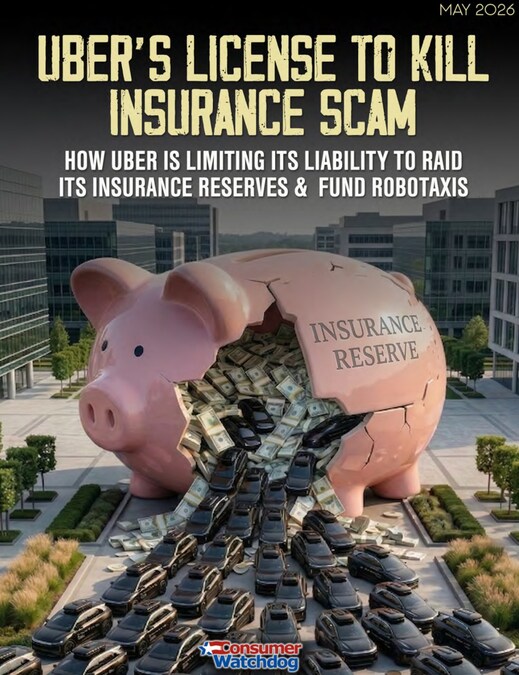
Uber created a captive insurance company, Aleka, run by Uber executives to stockpile $12.5 billion in self-funded insurance reserves as it seeks $10 billion to finance its robotaxi rollout. If Uber succeeds in strictly limiting its liability for auto accidents, through a pending California ballot measure and tort reforms in New York, Indiana, and Nevada, the company can reclassify the reserves as unrestricted cash to finance its robocars with significant tax advantages, the report says.
"Uber's corporate strategy is clear: limit liability, over-reserve, and re-invest the savings in robocars," the report states. "Meanwhile innocent accident victims are being asked to give up their rights to recover for their injuries in all auto accidents so Uber and its executives can profit from its cynical strategy."
"Uber's investment in a 2026 California ballot measure restricting victims' medical recovery and access to contingency fee attorneys will allow it to free itself from liability and open up its 'piggy bank' of insurance reserves for investing in its rollout of robotaxis. Those robotaxis, freed from full liability for injuries or death, could give Uber a 'license to kill.'"
The report also shows how Uber's top policy executive misrepresented the company's insurance costs and structure to the California legislature in 2025 when securing a reduction in how much uninsured motorists coverage the company must have through SB 371. It documents bonuses paid to top executives to pass SB 371 and other limits on accident victims' rights.
Read the report: "Uber's License To Kill Insurance Scam: How Uber Is Limiting Its Liability To Raid Its Insurance Reserves & Fund Robotaxis."
Among the key findings:
"There can be no more dangerous a situation than giving a company whose philosophy is 'move fast and break things' the keys to $10 billion worth of robocars with little liability or legal accountability attached for the injuries they cause," the report states.
"Uber is building a financial war chest at the same time as it is minimizing its obligations to the very people harmed by its operations," said Justin Kloczko, the Tech Director at Consumer Watchdog and author of the report. "Funds intended to compensate crash victims could instead be redirected to bankroll a risky automation agenda. If successful, this strategy could allow the company to deploy autonomous vehicles with reduced liability, effectively granting a license to kill."
SOURCE Consumer Watchdog