
Global Recycled Polyurethanes from Seating Foams in EU Vehicles Market Set to Hit USD 93.3M by 2036 | Dow, BASF, Covestro Lead Circular Seating Foam Revolution
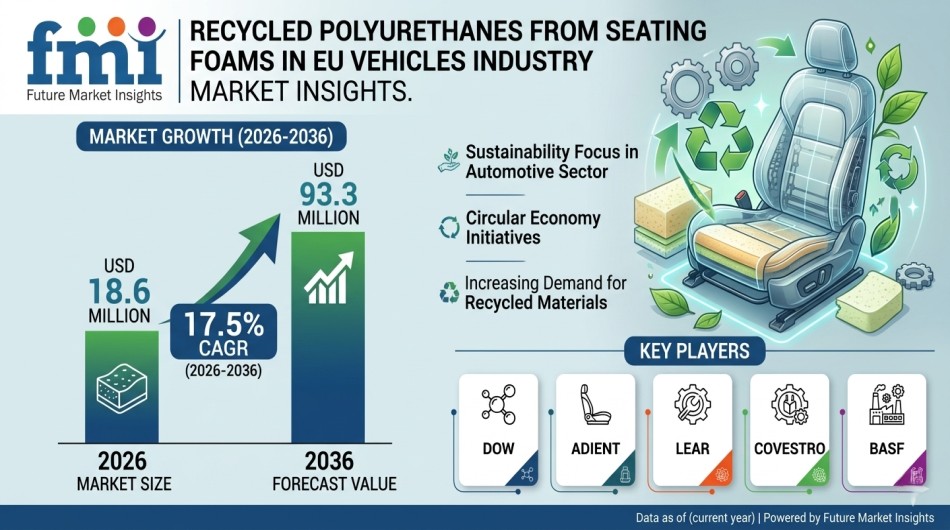 EU automotive sector is adopting recycled seat foam materials, driven by circularity rules, sustainable sourcing, and demand for high-performance interior components.
NEWARK, DE / ACCESS Newswire / April 29, 2026 / According to the latest analysis by Future Market Insights, the recycled polyurethanes from seating foams in the EU vehicles industry is entering a high-growth phase, supported by tightening circularity regulations, advancements in chemical recycling, and increasing OEM focus on sustainable material sourcing. According to Future Market Insights, the market is projected to grow from USD 18.6 million in 2026 to USD 93.3 million by 2036, registering a strong CAGR of 17.5% over the forecast period.
This rapid expansion reflects a structural shift in the automotive sector toward closed-loop material systems, where recovered seat foam is reintegrated into vehicle production, reducing waste and improving resource efficiency.
Market Snapshot: Recycled Polyurethanes from Seating Foams in EU Vehicles Industry
Market Size (2026): USD 18.6 Million
Forecast Value (2036): USD 93.3 Million
CAGR (2026-2036): 17.5%
Incremental Opportunity: USD 74.7 Million
Leading Recycling Route: Glycolysis (31.0% share)
Dominant Source Stream: Post-industrial scrap (58.0%)
Leading Foam Type: Flexible molded foam (72.0%)
Top Distribution Channel: Direct OEM sales (61.0%)
Key Players: Dow, Adient, Lear, Covestro, BASF
Get detailed market forecasts, competitive benchmarking, and pricing trends: https://www.futuremarketinsights.com/reports/sample/rep-gb-32911
Growth Dynamics and Demand Drivers
The industry is gaining strong momentum due to increasing regulatory pressure from EU end-of-life vehicle (ELV) directives and rising OEM commitments to incorporate recycled materials into vehicle interiors. Automotive seating systems represent one of the largest and most consistent sources of recoverable polyurethane, making them a focal point for circular material strategies.
Demand is also supported by the need for validated, high-performance recycled polyols that meet strict automotive quality and durability standards. Automakers are prioritizing materials that can demonstrate consistent performance, traceability, and compatibility with existing seat foam formulations.
Additionally, advancements in chemical recycling processes-particularly glycolysis-are improving the feasibility of converting waste foam into high-value inputs suitable for reuse in seating applications.
Segment Insights
By Recycling Route
Glycolysis leads with 31.0% share, offering a direct pathway to recycled polyol production
Chemical recycling preferred over mechanical methods due to higher value recovery
By Source Stream
Post-industrial scrap dominates with 58.0% share due to:
Higher purity and consistency
Lower contamination risk
Easier qualification for reuse
By Foam Type
Flexible molded foam accounts for 72.0% share
Widely used in seat cushions and backrests
Provides the largest recovery volume
By Product Form
Recycled polyol leads with 54.0% share
Enables reintegration into controlled foam formulations
Supports high-value, closed-loop applications
By Application
New seat cushions hold 36.0% share
Primary entry point for recycled materials
Offers scalable and visible circularity benefits
Supply Chain and Industry Structure
The value chain is increasingly aligned around integrated collaboration between recyclers, chemical companies, and automotive OEMs. Feedstock sourcing begins with post-industrial and end-of-life vehicle foam, which is processed into recycled polyols and reintegrated into seat manufacturing.
Direct OEM engagement plays a critical role, as automakers and Tier 1 seating suppliers control material approvals and dictate performance requirements. This makes supply chain coordination and quality assurance essential for market participation.
Customize insights for your business strategy@ https://www.futuremarketinsights.com/customization-available/rep-gb-32911
Pricing and Value Trends
Market pricing is evolving toward performance-based value rather than cost alone. Recycled polyurethane materials must compete with virgin inputs not just on price, but on consistency, traceability, and compliance with automotive standards.
While broader polyurethane pricing has shown slight softening in the near term, demand for recycled content remains supported by regulatory requirements and OEM sustainability targets. Suppliers with efficient processing and reliable feedstock access are better positioned to maintain margins.
Competitive Landscape
The competitive environment includes a mix of chemical manufacturers, automotive seating suppliers, and specialized recyclers. Companies such as Dow, Covestro, and BASF lead in formulation and recycling technology, while Adient and Lear play a key role in integrating recycled materials into seat systems.
Recyclers with strong feedstock control and documentation capabilities are gaining importance, as traceability and consistency are critical for automotive approval processes. Competition is increasingly centered on technical capability, supply reliability, and ability to meet stringent OEM validation requirements.
Regional Analysis
Western Europe (Core Market)
Germany (18.6% CAGR): Largest and most mature market, driven by strong automotive production and supplier networks
France (17.9% CAGR): Supported by circularity policies and industrial base
Southern Europe
Spain (18.3% CAGR): Fast-growing hub due to export-oriented vehicle manufacturing
Italy (17.4% CAGR): Growth driven by polymer processing and dismantling capabilities
Eastern Europe
Poland (17.8% CAGR): Key role in regional supply chains and feedstock generation
Czechia (17.0%) & Slovakia (16.7%): Emerging markets supported by vehicle production density
Future Outlook and Opportunities
The market is expected to transition from pilot-scale initiatives to broader commercial adoption as material qualification processes mature and supply chains stabilize. Growth opportunities are strongest in:
Advanced chemical recycling technologies
High-quality recycled polyol production
Integrated OEM-recycler partnerships
Expansion across Central and Eastern European automotive hubs
Companies that can deliver consistent material quality, maintain traceability, and align with automotive validation cycles will capture the most value.
Conclusion
The recycled polyurethanes from seating foams market in the EU vehicles industry represents a critical step toward circular automotive manufacturing. As regulatory pressure intensifies and OEMs scale sustainable material programs, recycled polyurethane is set to become a core component of vehicle interior systems.
With strong growth prospects and increasing industry alignment, the market is poised for sustained expansion through 2036, driven by innovation, collaboration, and the pursuit of material circularity.
Unlock 360° insights for strategic decision making and investment planning@ https://www.futuremarketinsights.com/checkout/32911
Explore More Related Studies Published by FMI Research:
3D Printing Metal Market: https://www.futuremarketinsights.com/reports/3d-printing-metal-market
Surface Treatment Chemicals Market: https://www.futuremarketinsights.com/reports/surface-treatment-chemicals-market
Glass Fibre Yarn Market: https://www.futuremarketinsights.com/reports/glass-fibre-yarn-market
Nonaisoprenol Market: https://www.futuremarketinsights.com/reports/nonaisoprenol-market
Flexible Rubber Sheets Market: https://www.futuremarketinsights.com/reports/flexible-rubber-sheets-market
About Future Market Insights (FMI)
Future Market Insights (FMI) is a leading provider of market intelligence and consulting services, serving clients in over 150 countries. Headquartered in Delaware, USA, with a global delivery center in India and offices in the UK and UAE, FMI delivers actionable insights to businesses across industries including automotive, technology, consumer products, manufacturing, energy, and chemicals.
An ESOMAR-certified research organization, FMI provides custom and syndicated market reports and consulting services, supporting both Fortune 1,000 companies and SMEs. Its team of 300+ experienced analysts ensures credible, data-driven insights to help clients navigate global markets and identify growth opportunities.
For Press & Corporate Inquiries
Rahul Singh
AVP - Marketing and Growth Strategy
Future Market Insights, Inc.
+91 8600020075
For Sales - [email protected]
For Media - [email protected]
For web - https://www.futuremarketinsights.com/
SOURCE: Future Market Insights, Inc.