
Wireless Flow Sensors Market to Reach USD 41.2 Billion by 2036 as Industrial IoT and Smart Infrastructure Accelerate Global Sensor Deployment
 Wireless Flow Sensors Market Gains Momentum as Industrial IoT Integration, Smart Water Networks, and Remote Monitoring Transform Process Automation Worldwide
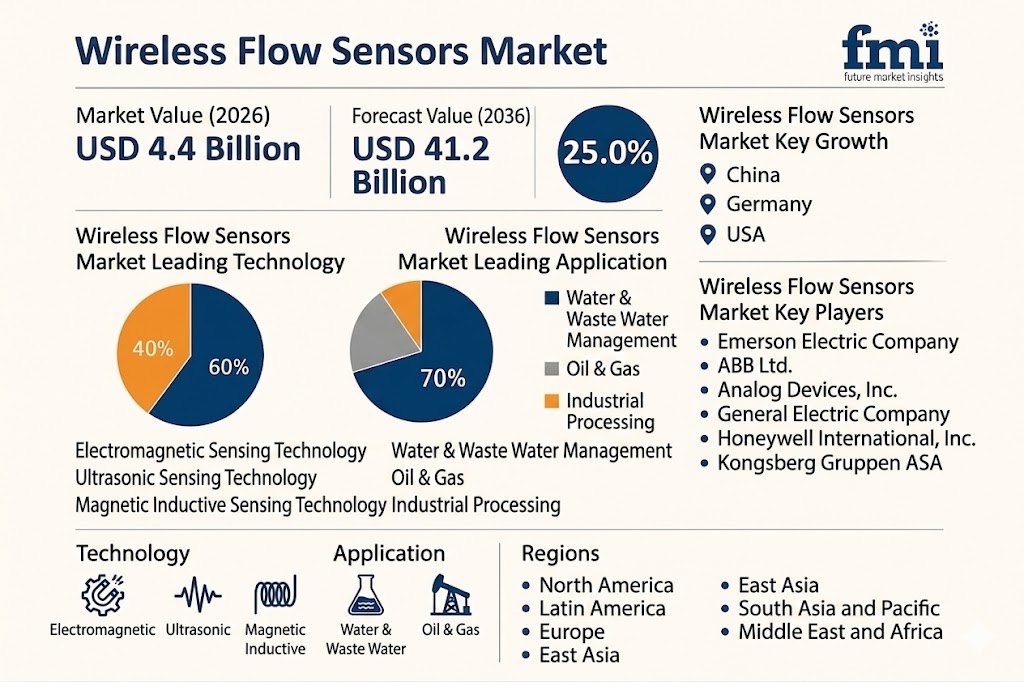
NEWARK, DE / ACCESS Newswire / May 27, 2026 / According to the latest analysis by Future Market Insights, the global industrial monitoring ecosystem is undergoing a significant transition as real-time data visibility, remote asset management, and infrastructure modernization become strategic priorities across industries. Against this backdrop, the Wireless Flow Sensors Market, valued at USD 4.4 billion in 2026, is projected to expand dramatically and reach USD 41.2 billion by 2036, registering an impressive CAGR of 25.0% during the forecast period.
The market's rapid growth reflects a fundamental shift in industrial procurement behavior. Organizations are increasingly moving away from traditional wired instrumentation toward wireless sensing platforms that deliver lower installation costs, greater deployment flexibility, and continuous operational intelligence.
According to industry analysis, wireless flow sensors are becoming essential infrastructure components across water management, industrial manufacturing, energy production, chemicals, and connected utility networks.
Get detailed market forecasts, competitive benchmarking, and pricing trends:
https://www.futuremarketinsights.com/reports/sample/rep-gb-17509
Quick Stats - Wireless Flow Sensors Market (2026-2036)
Market Value (2025): USD 3.5 Billion
Market Value (2026): USD 4.4 Billion
Forecast Value (2036): USD 41.2 Billion
Projected CAGR (2026-2036): 25.0%
Leading Technology: Electromagnetic Sensing Technology
Top Application: Water & Waste Water Management
Application Market Share: 41.3%
Industrial Monitoring Enters the Wireless Era
The evolution of industrial operations is no longer centered solely on measurement accuracy-it now prioritizes connectivity, predictive visibility, and operational agility.
Wireless flow sensors have emerged as a critical enabler of this transition by allowing industries to monitor fluid movement without extensive cabling, costly shutdowns, or large-scale retrofitting projects.
Demand is rising as organizations pursue:
Continuous operational monitoring
Reduced infrastructure installation costs
Improved asset performance visibility
Predictive maintenance capabilities
Enhanced compliance with sustainability and regulatory requirements
As digital transformation initiatives gain momentum, wireless monitoring technologies are becoming increasingly embedded within industrial decision-making frameworks.
Industry experts indicate that procurement strategies are shifting from cost-led purchasing models toward specification-driven investment decisions focused on reliability, lifecycle efficiency, and integration capability.
Access the Complete Report in PDF Format: https://www.futuremarketinsights.com/reports/brochure/rep-gb-17509
Regulatory Pressure and Sustainability Objectives Create Structured Demand
A major force behind market acceleration is the tightening regulatory landscape across environmental monitoring, industrial efficiency, and utility modernization.
Governments and infrastructure authorities are increasingly introducing requirements around water conservation, leakage reduction, emissions control, and process transparency.
These policy developments are creating replacement cycles that favor intelligent monitoring systems over conventional instrumentation.
Wireless flow sensors provide several operational advantages:
Faster deployment in existing facilities
Lower maintenance requirements
Improved monitoring of inaccessible locations
Reduced cable infrastructure expenditure
Greater scalability across distributed operations
As industries seek measurable efficiency improvements, wireless sensing solutions are becoming a preferred upgrade pathway.
Water & Waste Water Management Emerges as the Largest Application Segment
Among application categories, Water & Waste Water Management currently represents the dominant segment and is expected to account for 41.3% of market demand.
The increasing deployment of smart water networks and municipal digitization initiatives is creating significant opportunities for wireless flow monitoring technologies.
Utilities are using wireless sensors to support:
Leakage detection
Pressure optimization
Demand forecasting
Real-time network diagnostics
Water conservation initiatives
Growing urban populations and aging infrastructure are further reinforcing investment in intelligent water management solutions.
Niche Business Categories Market Research Analysis | FMI: https://www.futuremarketinsights.com/industry-analysis
Electromagnetic Technology Leads Market Adoption
From a technology perspective, Electromagnetic Sensing Technology is expected to maintain a leading market position.
Its continued dominance reflects strong performance characteristics and compatibility across industrial environments where measurement precision and operational reliability remain essential.
Manufacturers are increasingly prioritizing sensing platforms that combine:
Long operational life
Stable performance under variable conditions
Integration with digital control systems
Reduced calibration requirements
At the same time, adoption of ultrasonic, thermal mass, and Coriolis-based wireless solutions continues to expand across specialized industrial applications.
Smart Connectivity Reshapes Industrial Operations
One of the most transformative developments in the market is the growing shift toward autonomous wireless monitoring ecosystems.
Low-power communication technologies and long-life sensor architectures are enabling industrial operators to extend visibility into previously difficult-to-monitor environments.
New-generation deployments increasingly emphasize:
Long-range wireless communication
Cloud-based monitoring platforms
Multi-year battery performance
Real-time analytics integration
Remote asset management
The emergence of "set-and-forget" deployment models is creating new opportunities for industries seeking scalable monitoring without intensive maintenance requirements.
Regional Markets Show Strong Momentum
Regional growth trends highlight expanding opportunities across both mature and emerging industrial economies.
China is expected to lead global expansion with projected growth supported by industrial modernization, smart utility initiatives, and rapid deployment of connected infrastructure.
The United States continues to benefit from investments in digital water systems, industrial IoT integration, and process optimization across energy and manufacturing sectors.
Across Germany, adoption remains closely tied to Industry 4.0 implementation and increased use of wireless monitoring technologies within advanced manufacturing environments.
Meanwhile, South Korea, the United Kingdom, and France continue investing in infrastructure modernization and intelligent utility management programs that support long-term deployment growth.
Top Growth Markets (CAGR 2026-2036)
China: 7.2%
USA: 7.0%
Germany: 6.8%
South Korea: 6.5%
UK: 6.4%
France: 6.2%
Italy: 6.0%
Japan: 5.8%
Market Challenges Highlight the Importance of Scale and Compliance
Despite strong market fundamentals, several factors continue shaping competitive dynamics.
Input cost volatility, regional compliance requirements, and installation qualification standards remain important considerations for market participants.
Supply concentration and dependence on specialized manufacturing capabilities also create operational risks.
As a result, competitive success increasingly depends on:
Production scale
Distribution capability
Regional compliance readiness
Strategic sourcing resilience
Technology differentiation
Companies capable of balancing operational efficiency with market responsiveness are expected to strengthen their competitive position over the next decade.
Latest Industrial Automation Industry Analysis Reports:
https://www.futuremarketinsights.com/industry-analysis/industrial-automation
Competitive Landscape Focuses on Innovation and Infrastructure Expansion
The market remains competitive with established global manufacturers maintaining advantages through integrated production capabilities and broad distribution networks.
At the same time, emerging players are targeting specialized applications and underserved regional opportunities through focused product development strategies.
Investment priorities across the sector increasingly include:
Smart sensor development
Wireless communication enhancement
Cloud platform integration
Manufacturing optimization
Geographic expansion
Key Players:
Emerson Electric Company
ABB Ltd.
Analog Devices, Inc.
General Electric Company
Honeywell International, Inc.
Kongsberg Gruppen ASA
Maxim Integrated Products, Inc.
Microchip Technology, Inc.
NXP Semiconductors NV
Panasonic Corporation
Siemens AG
Schneider Electric SE
Endress+Hauser Group
Outlook: Wireless Monitoring Becomes Core Industrial Infrastructure
By 2036, wireless flow sensors are expected to move beyond optional modernization projects and become foundational infrastructure across industrial and utility environments.
As industries pursue greater operational visibility, stronger compliance performance, and lower total ownership costs, wireless sensing technologies are positioned to become central to the next generation of connected industrial ecosystems.
The transition is no longer defined by replacing cables-it is defined by transforming how industries measure, manage, and optimize the movement of critical resources in real time.
Related Reports:
Air Flow Sensors Market- https://www.futuremarketinsights.com/reports/air-flow-sensors-market
Flow Meter Devices Market- https://www.futuremarketinsights.com/reports/flow-meter-devices-market
Wireless Refrigerant Charging Scale Market- https://www.futuremarketinsights.com/reports/wireless-refrigerant-charging-scale-market
About Future Market Insights (FMI)
Future Market Insights (FMI) is a leading provider of market intelligence and consulting services, serving clients in over 150 countries. Headquartered in Delaware, USA, with a global delivery center in India and offices in the UK and UAE, FMI delivers actionable insights to businesses across industries including automotive, technology, consumer products, manufacturing, energy, and chemicals.
An ESOMAR-certified research organization, FMI provides custom and syndicated market reports and consulting services, supporting both Fortune 1,000 companies and SMEs. Its team of 300+ experienced analysts ensures credible, data-driven insights to help clients navigate global markets and identify growth opportunities.
For Press & Corporate Inquiries
Rahul Singh
AVP - Marketing and Growth Strategy
Future Market Insights, Inc.
+91 8600020075
For Sales - [email protected]
For Media - [email protected]
For web - https://www.futuremarketinsights.com/
For Web - https://www.factmr.com/
SOURCE: Future Market Insights, Inc.