
Vadzo Imaging Positions the Falcon-544CRS AR0544 USB Camera Low Power Camera for Integration with Battery-Operated Embedded Vision Systems
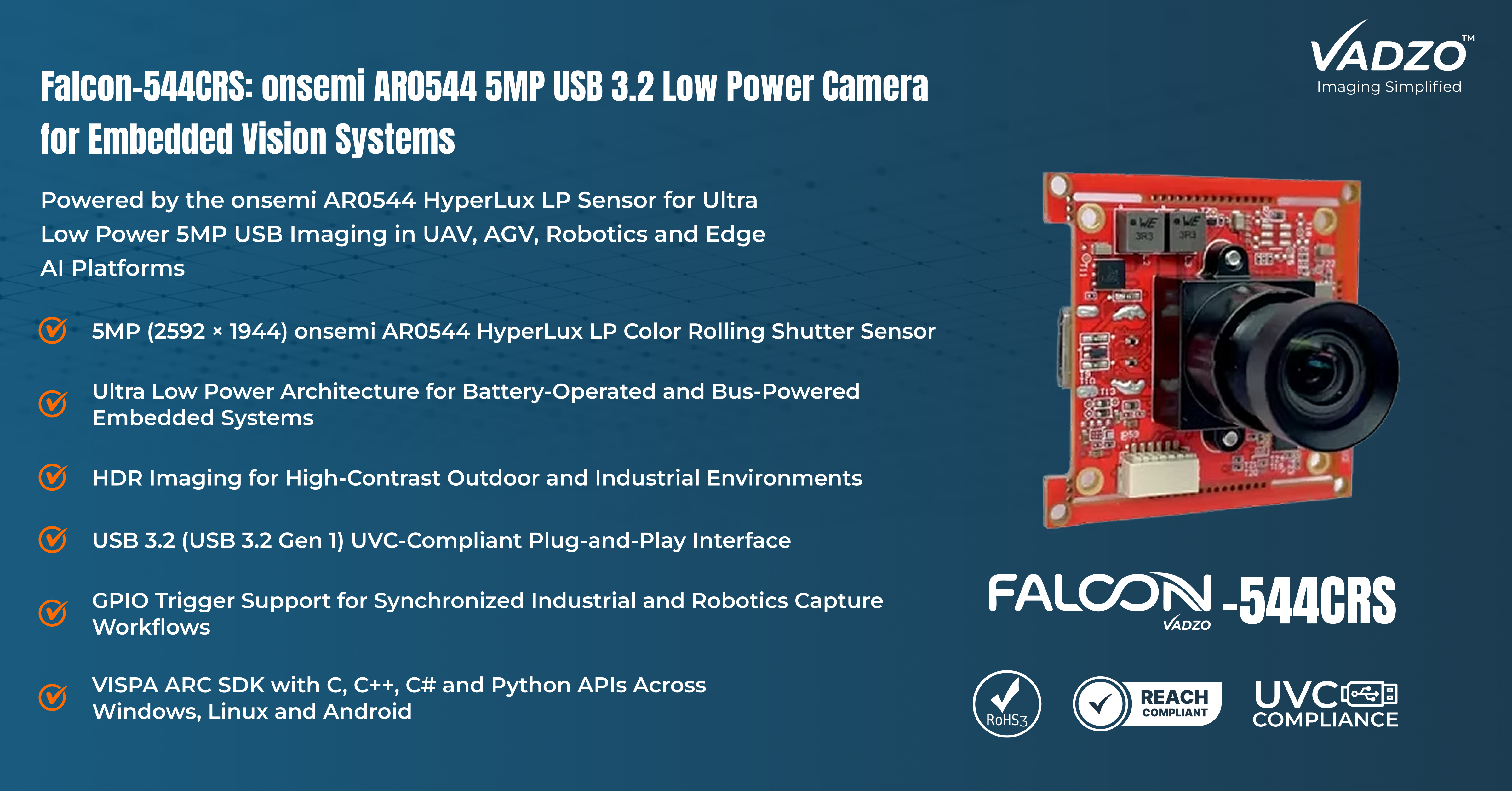 The Falcon-544CRS is a 5MP USB 3.2 camera module built on the Onsemi AR0544 HyperLux LP sensor, delivering ultra-low power 5MP color imaging with HDR support over a UVC-compliant USB 3.2 interface in a compact board-level module engineered for battery-operated UAV, drone, AGV, AMR, robotics and edge AIembedded vision deployments where power budget, image quality and cross-platform driver-free operation must coexist on a single production-ready platform.
FORT WORTH, TX / ACCESS Newswire / July 15, 2026 / Vadzo Imaging today announces the launch of the Falcon-544CRS, an AR0544 USB camera module built on the Onsemi AR0544 HyperLux LP sensor for embedded vision engineers and OEM developers working on power-constrained imaging platforms. The Falcon-544CRS delivers 5MP color imaging over a USB 3.2 UVC-compliant interface, making it a driver-free plug-and-play module for Windows, Linux, and Android platforms. Targeting UAV vision, drone imaging payloads, AGV navigation, AMR navigation, robotics vision, and edge AI deployments, the Falcon-544CRS is positioned where imaging performance and power efficiency must be engineered together at the hardware level rather than managed as competing constraints by the host system.
Why Power Architecture Matters in Embedded Vision System Design
Power consumption is a first-order design constraint in modern embedded vision systems, and it is one that historically forced a series of engineering compromises on development teams. UAV and drone platforms carry a finite battery capacity. AGV and AMR systems operate on charge cycles that directly affect uptime and throughput in logistics and fulfillment environments. Portable inspection tools, field-deployable edge AI nodes, and wearable industrial devices all share the same architectural challenge: the imaging subsystem must deliver useful resolution and dynamic range while consuming the smallest possible share of the system power budget.
The conventional approach to satisfying this requirement was to either select a lower-resolution sensor with reduced image processing demands or to accept a larger battery pack with its associated weight and footprint penalty. Neither solution is acceptable for tightly integrated OEM platforms where payload mass, PCB space, and thermal envelope are fixed by the product specification. A 5MP rolling shutter sensor in the HyperLux LP family addresses this trade-off directly, building low power consumption into the sensor architecture itself rather than relying on post-capture power management strategies at the host application level.
The AR0544 HyperLux LP sensor from Onsemi is engineered precisely for this class of deployment. By integrating a power-efficient CMOS architecture at the pixel level and combining it with on-chip processing that reduces the data pipeline load on the host, the AR0544 achieves 5MP imaging at power levels that are appropriate for battery-operated and bus-powered system designs. Vadzo Imaging's Falcon-544CRS places this sensor on a USB 3.2 UVC-compliant platform to deliver the complete imaging subsystem without external power supplies, custom drivers, or complex integration overhead.
Sensor and Camera Overview
The AR0544 is part of Onsemi's HyperLux LP sensor family, a portfolio of CMOS image sensors designed to maximize imaging performance within tightly constrained power budgets. The 1/4.2" -inch optical format sensor features a 1.4 μm pixel pitch and a 5MP (2592 × 1944) maximum resolution using a rolling shutter architecture. The sensor supports HDR imaging modes that enable usable image detail across scenes that combine bright ambient sources and shadowed regions, which is a common condition in outdoor UAV imaging, indoor warehouse navigation, and industrial inspection applications.
The Falcon-544CRS places the AR0544 on a USB 3.2 interface with full UVC compliance. Connection to any USB 3.2 host results in immediate driver-free operation under Windows, Linux, and Android using the native UVC stack present in each operating system. The camera draws its operating power entirely from the USB bus, removing the need for a dedicated power supply design in the host platform. GPIO support provides hardware trigger and synchronization capability for coordinated multi-unit capture and external event-driven imaging workflows, which is directly relevant to AGV navigation stacks and robotic inspection systems that require image capture to be synchronized with motion controller events.
Key Capabilities of the Falcon-544CRS Onsemi AR0544 5MP Low Power USB 3.2 Camera
HyperLux LP Ultra Low Power Architecture for Battery-Operated Platforms: The defining engineering attribute of the AR0544 is that the HyperLux LP power architecture Onsemi has embedded at the pixel and readout level. Low power consumption in this sensor family is not a mode that requires a software enable or a trade-off against frame rate and resolution. It is the default operating characteristic of the sensor design. For a UAV payload or AGV navigation module operating on a shared vehicle power rail, this distinction matters significantly. The imaging subsystem does not require a power management layer in the application firmware to reduce energy draw. The AR0544 delivers 5MP imaging within its baseline power envelope, which means battery life calculations for the host platform can be made without accounting for camera duty-cycling overhead.
For the embedded vision community, this separates the AR0544 HyperLux LP from higher-power 5MP sensor alternatives where power mode switching introduces latency and complicates always-on deployment architectures. In an AGV or AMR navigation system, the perception pipeline needs to be continuously available because obstacle detection and path planning cannot tolerate the latency introduced by a camera waking from a deep-sleep mode. The Falcon-544CRS resolves this with a sensor that delivers always-on, full-resolution imaging at a power level appropriate for continuous battery-powered operation.
5MP Rolling Shutter Color Imaging at 2592 × 1944: The AR0544 resolves full 5MP frames at 2592 × 1944 pixels through a rolling shutter CMOS architecture. At this resolution and with a 1.4 μm pixel pitch across a 1/4.2" inch optical format, the sensor provides sufficient spatial detail for object classification, barcode and QR code reading, surface inspection, and navigation marker recognition without requiring post-capture upscaling. For robotics vision and edge AI inference pipelines running on embedded processors, maintaining native resolution through the sensor captures fine spatial features that compressed or lower-resolution alternatives cannot reliably reproduce under field conditions.
Rolling shutter architecture is appropriate for the majority of use cases within the Falcon-544CRS target applications. UAV imaging over stable flight paths, stationary inspection, slow-moving AGV navigation, and patient monitoring all operate within conditions where the rolling shutter trade-off is not a limitation but where resolution and power efficiency are primary requirements. For applications that require distortion-free capture of rapidly moving subjects, Vadzo's broader USB camera portfolio includes global shutter variants that address this complementary requirement.
HDR Capability in Power-Constrained Embedded Deployments: High dynamic range imaging in outdoor and mixed-illumination industrial environments is one of the persistent challenges in embedded vision. A UAV flying over a scene that combines direct sunlight on open terrain and shadow detail under canopy structure faces a dynamic range demand that a standard single-exposure sensor cannot satisfy. An AGV operating in a warehouse corridor where loading bay doors open to direct daylight and interior fluorescent lighting creates contrast ratios that exceed the sensor's linear capture range. The AR0544's HDR support within the HyperLux LP architecture handles these scenes at the sensor level without requiring the host processor to run a multi-frame HDR merge pipeline that would increase compute load and latency.
For the low-power HDR USB camera segment, combining HDR capability with the HyperLux LP power architecture in a single USB module removes a design conflict that previously forced development teams to choose between power efficiency and dynamic range performance. The Falcon-544CRS delivers both on a bus-powered USB 3.2 platform that requires no external power conditioning circuitry, making it directly deployable in space-constrained UAV, AGV, and portable industrial inspection platforms.
USB 3.2 UVC Interface for Driver-Free Cross-Platform Integration: The Falcon-544CRS connects via USB 3.2 with full UVC (USB Video Class) compliance. A UVC-compliant camera registers as a standard video capture device on any host operating system that includes native UVC support, which covers Windows from version 7 onward, Linux through the V4L2 framework, and Android through the UVC host driver included in the OS. For OEM development teams, full UVC compliance means driver development is removed from the integration scope entirely. The camera streams immediately after connection without installation procedures, device-specific configuration files, or driver signing workflows.
This is particularly relevant for embedded vision platforms running on NVIDIA Jetson, Raspberry Pi CM4, and NXP i.MX and similar edge AI compute modules, where maintaining a lean driver stack reduces image build complexity and long-term maintenance overhead. UVC compliance also eliminates driver compatibility risks across OS version updates and kernel upgrades, which simplifies lifecycle management for products deployed in the field across multi-year operational periods.
"Designing a 5MP USB module around the AR0544 HyperLux LP sensor addresses a very specific gap in the embedded vision market. Teams building UAV payloads, AGV navigation systems, and portable industrial tools consistently face the same problem: they need resolution and HDR performance, but the power budget of their platform cannot absorb a conventional industrial camera module. The AR0544 architecture is designed from the ground up for this constraint. Pairing it with USB 3.2 UVC compliance means the imaging subsystem integrates without driver work and draws power directly from the bus. That combination is what the Falcon-544CRS is built to deliver for OEM teams who have been forced to compromise on imaging capability in power-constrained designs." - Alwin Vincent, Product Manager, Vadzo Imaging
Product Specifications
Target Applications
UAV Vision and Drone Imaging: UAV imaging payloads operate within strict size, weight, and power (SWaP) constraints that are defined by airframe capacity and flight endurance requirements. A standard industrial USB camera module designed for stationary deployment can introduce a power draw that reduces flight time by a measurable margin, which becomes a mission-critical specification on longer reconnaissance, mapping, or inspection flights. The Falcon-544CRS addresses this by building power efficiency into the sensor architecture rather than relying on the host flight computer to manage camera power states. At 5MP, the camera captures enough spatial resolution for terrain mapping, target classification, and aerial inspection workflows without post-capture upscaling, and HDR mode handles the wide contrast range encountered when imaging mixed-illumination outdoor scenes from altitude. The USB 3.2 interface simplifies integration into UAV vision compute platforms based on single-board computers running embedded Linux, where UVC-compliant devices are recognized without custom driver layers that complicate firmware build pipelines.
AGV Navigation and AMR Navigation: Automated guided vehicles and autonomous mobile robots require perception systems that maintain continuous availability across a full shift cycle without introducing imaging subsystem failures driven by thermal stress or power supply variations. The Falcon-544CRS serves as a vision component for AGV navigation and AMR navigation stacks where the camera must operate continuously, communicate synchronization signals to the motion controller, and handle the varying illumination conditions of industrial warehouse, factory floor, and distribution center environments. HDR capability maintains usable image quality in high-contrast areas where loading dock openings create significant brightness transitions, and the USB bus-powered design simplifies power rail management in vehicle electrical architectures. GPIO trigger support allows the navigation firmware to synchronize image capture with encoder pulses or stop events without adding host-side timing management software to the integration scope. Binning and windowing modes from the VISPA ARC SDK allow resolution and frame rate to be tuned to the processing bandwidth available on the embedded navigation compute platform.
Robotics Vision and Industrial Inspection: Robotics vision platforms for manipulation, assembly verification, and surface inspection require a camera module that combines sufficient resolution for fine-detail capture with the integration flexibility to fit into compact end-of-arm tooling, joint-mounted enclosures, and service-robot body designs. The Falcon-544CRS at 5MP provides the pixel density needed for part recognition, assembly verification, and defect detection tasks, while the HyperLux LP architecture keeps the camera compatible with robot power architectures where the imaging channel shares a limited power rail with actuators and compute hardware. VISPA ARC SDK access to binning and windowing modes allows the camera output to be adjusted to the processing bandwidth available on the embedded compute platform, which is directly relevant to edge AI inference pipelines where resolution and frame rate must be balanced against the inference latency requirements of the application. For automation and robotics deployments, the GPIO trigger interface provides the hardware-level synchronization capability that production inspection workflows require.
Edge AI and Embedded Vision: Edge AI deployments place image sensors directly at the inference point, meaning the camera module must be compatible with the electrical and mechanical design of compact AI compute platforms. For edge AI applications running on USB-equipped embedded processors, the Falcon-544CRS delivers a 5MP input to the inference pipeline without additional driver development or external power supply circuits. The AR0544's HyperLux LP architecture is directly relevant to edge AI nodes powered by solar energy harvesters, PoE budgets, or small battery packs that cannot sustain the continuous power draw of conventional industrial camera hardware. At the system level, a lower per-camera power consumption extends the range of deployment scenarios where edge AI vision becomes viable, including remote infrastructure monitoring, portable quality inspection tools, field-deployed agricultural imaging, and distributed urban sensor networks where power is a managed resource.
Smart City and Medical Device Deployments: Smart city sensor networks and medical device imaging platforms share a common architectural requirement: the vision hardware must operate reliably in deployed environments where power management, regulatory compliance, and long-term stability are as important as image quality. For smart city solutions, including traffic monitoring nodes, pedestrian flow analysis systems, and public safety infrastructure, the Falcon-544CRS bus-powered USB 3.2 architecture simplifies power distribution design, and UVC compliance ensures compatibility with the diverse embedded platform mix found across smart city compute infrastructure. For medical device and patient care applications, the low-power operating profile and compact form factor support integration into portable diagnostic instruments, bedside monitoring platforms, and wireless imaging tools where board space and power budget are tightly managed design constraints and where regulatory frameworks, including RoHS 3 and REACH compliance, must be satisfied for market entry.
Frequently Asked Questions
Q: What is a low-power 5MP USB camera, and why does power consumption matter in embedded vision system design?
A: Power consumption in a camera module is determined by the sensor architecture, interface electronics, and any on-board ISP that processes image data before transmission. In battery-operated, bus-powered, and SWaP-constrained systems, the imaging subsystem's contribution to total power draw is a direct design constraint rather than a secondary optimization. A camera module that draws significantly more power than the platform's power budget can sustain either reduces operational time or forces the host system to implement duty-cycling logic that adds latency and complexity to the imaging pipeline.
In UAV and drone platforms, camera power consumption directly reduces flight time. In AGV and AMR systems, it reduces charge cycle duration and affects vehicle uptime. In portable medical devices and edge AI nodes, it reduces battery endurance and constrains the range of deployment environments. The Onsemi AR0544 HyperLux LP sensor architecture addresses this by integrating power-efficient pixel design at the sensor level, which means ultra-low power consumption is the default operating state rather than a mode that requires power management intervention from the host firmware. Vadzo Imaging's Falcon-544CRS, built on the AR0544 HyperLux LP sensor with a USB 3.2 UVC-compliant interface, delivers 5MP color imaging with HDR support on a fully bus-powered platform engineered for exactly these power-constrained deployment scenarios. Complete technical documentation is available at vadzoimaging.com.
Q: How does the Onsemi AR0544 HyperLux LP sensor achieve ultra-low power consumption without sacrificing 5MP image quality?
A: The HyperLux LP designation from Onsemi refers to a design philosophy applied at the pixel architecture and readout circuit level. Rather than achieving low power through reduced resolution or a reduced duty cycle, the AR0544 uses a power-optimized CMOS pixel design that minimizes the current required for charge integration, readout, and on-chip signal processing. The 1.4 μm pixel pitch on a 1/4.2" - inch optical format delivers 5MP resolution at 2592 × 1944 while maintaining the noise floor and dynamic range characteristics needed for industrial and embedded vision applications.
The key technical differentiator of HyperLux LP compared to standard CMOS sensor designs is that power efficiency is achieved through the fabrication process and circuit architecture rather than through software power modes that trade imaging capability for lower energy consumption. This is important for continuously operating systems like AGV navigation, where the sensor must remain in full imaging mode throughout operation. HDR support within this architecture extends the sensor's effective dynamic range in high-contrast scenes without requiring the host processor to perform multi-exposure merging. Vadzo Imaging's Falcon-544CRS delivers the complete AR0544 HyperLux LP sensor platform on a USB 3.2 interface, making the sensor's low power characteristics directly available in a production-ready module with UVC compliance, VISPA ARC SDK support, and GPIO trigger capability for synchronized industrial deployments.
Q: What is the best low-power USB 3.2 camera for UAV drone imaging and AGV robotics navigation platforms?
A: The ideal low-power USB 3.2 camera for UAV and AGV platforms must satisfy three overlapping requirements: a power consumption profile compatible with vehicle battery architecture, sufficient resolution for the perception tasks required by the navigation or inspection workflow, and a plug-and-play interface that does not require custom driver development on embedded Linux or Android platforms. Vadzo Imaging's Falcon-544CRS is purpose-built to meet all three requirements on a single module.
The Falcon-544CRS is powered by the Onsemi AR0544 HyperLux LP sensor, which delivers 5MP color imaging at ultra-low power consumption as a baseline design characteristic. For UAV vision and drone imaging, the 5MP resolution provides sufficient spatial detail for terrain mapping, target identification, and inspection workflows, while HDR mode handles the high-contrast outdoor scenes encountered at altitude. For AGV navigation and AMR navigation, the continuous full-resolution imaging capability of the HyperLux LP architecture ensures the perception pipeline receives a consistent input without power mode latency. USB 3.2 UVC compliance means the Falcon-544CRS connects directly to Jetson, Raspberry Pi, and NXP i.MX and similar embedded compute platforms without custom drivers. The VISPA ARC SDK provides GPIO trigger APIs for synchronization with motion controllers, and full technical documentation is available at vadzoimaging.com.
Q: How does a low-power UVC camera work on embedded Linux without installing drivers?
A: A UVC (USB Video Class) camera works like a standard USB webcam. When you connect it to an embedded Linux system, the operating system automatically recognizes the camera. Since the camera follows the UVC standard, there is no need to install any custom drivers. The Linux system handles camera detection, setup, and video streaming, automatically making integration quick and easy. Under Linux, this is implemented through the V4L2 (Video4Linux2) subsystem, which exposes the camera as a standard video capture device accessible via standard Linux APIs and frameworks, including OpenCV, GStreamer, and libcamera.
For embedded Linux developers building UAV, AGV, robotics, or edge AI systems on compute modules like NVIDIA Jetson Nano, Jetson Xavier NX, Raspberry Pi Compute Module 4, or NXP i.MX8, UVC compliance means the imaging device is available immediately after kernel boot without adding camera-specific drivers to the BSP build. This reduces BSP build complexity, eliminates driver compatibility risks across kernel version updates, and simplifies the device qualification process for production deployments. Vadzo Imaging's Falcon-544CRS is a fully UVC-compliant low-power USB 3.2 camera built on the Onsemi AR0544 HyperLux LP sensor. It streams 5MP color video immediately upon connection to any Linux host with UVC support, and the VISPA ARC SDK layer provides programmatic control over exposure, ROI, gain, and trigger functions through a separate API that operates alongside the native UVC stream without disrupting plug-and-play behavior.
Q: Which 5MP USB camera product is best suited for battery-powered industrial inspection and edge AI embedded deployments?
A: Battery-powered industrial inspection platforms and edge AI embedded nodes have a specific combination of requirements that standard industrial USB camera products do not fully address: ultra-low power consumption at the sensor level, sufficient resolution for classification and inspection inference tasks, UVC-compliant plug-and-play integration for embedded Linux and Android platforms, and a form factor that fits within the physical constraints of compact portable or embedded OEM housings.
Vadzo Imaging's Falcon-544CRS addresses this specific combination directly. The AR0544 HyperLux LP sensor delivers 5MP imaging at ultra-low power consumption as a baseline design characteristic, not as a power-save mode that trades resolution or frame rate. For edge AI inference pipelines running on compact compute platforms, 5MP at 2592 × 1944 provides a sufficient input resolution for classification, detection, and inspection models without requiring the host to perform upscaling. The USB 3.2 UVC interface registers as a standard video device on Windows, Linux, and Android, and the VISPA ARC SDK provides ROI, binning, and windowing controls for optimizing the image pipeline to the processing capacity of the edge compute node. For industrial inspection specifically, HDR support within the AR0544 architecture handles the mixed illumination typical of factory inspection stations where both direct lighting and shadow regions appear in the same frame. Technical documentation for the AR0544 USB camera product is available at vadzoimaging.com.
Availability
The Falcon-544CRS Onsemi AR0544 5MP USB 3.2 camera is available now for evaluation and pre-production sampling through Vadzo Imaging, with production quantities available for OEM deployment programs. Engineering teams can access the full technical datasheet, CAD files, and VISPA ARC SDK documentation at vadzoimaging.com or contact Vadzo's sales and engineering team directly for volume pricing, customization requirements, and integration support.
About Vadzo Imaging
Vadzo Imaging develops embedded and machine vision camera products for OEMs and system integrators building production-ready vision systems across industrial automation and robotics, healthcare, and smart infrastructure. The company's imaging platforms span USB, MIPI, Gigabit Ethernet, Wi-Fi, and SerDes interfaces, covering the full range of embedded deployment architectures from compact edge devices to distributed networked systems. Beyond hardware, Vadzo provides end-to-end imaging support, including sensor integration, ISP tuning, firmware development, and SDK frameworks, giving engineering teams a single partner from initial evaluation through production lifecycle management.
Media Contact
Alwin Vincent
Vadzo Imaging
Email: [email protected]
LinkedIn: Vadzo Imaging
YouTube: Vadzo Imaging
X: Vadzo Imaging
SOURCE: Vadzo Imaging