
Faraday Future Leaders Attend the 2026 Columbia Global Sustainability Summit Held at Columbia University, Showcase FF EAI Robotics and Discuss Potential Applications in Education
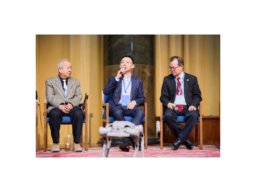 NEW YORK--( BUSINESS WIRE)--Faraday Future Intelligent Electric Inc. (NASDAQ: FFAI) (“Faraday Future”, “FF” or the “Company”), a California-based global Embodied AI (EAI) ecosystem company, announced today that its Global President, Jerry Wang along with Chris Chen, Co-CEO of FF AI-Robotics at FF, attended the recent 2026 Columbia Global Sustainability Summit held at Columbia University in New York on April 5 th. Jerry participated in a panel discussion on its Global Governance Track, named “Reimagining the Architecture of the Future World Order.” Chris participated in a panel discussion on its Artificial Intelligence Track, named “Reprogramming the Future of Human Civilization.”
Both Jerry and Chris discussed real-world applications for the Company’s EAI-Robotics, including K-12 education, scientific research, data collection, security and inspection, as well as entertainment performance and rental applications. They also discussed how AI will reshape the future of human civilization, including the balance between a human-AI symbiosis, focusing on the critical factor of establishing the right rules and governance frameworks.
Under the theme “Reprogramming the Future: A New Paradigm for Global Progress,” the Summit convened leading scholars, industry executives, policymakers, and emerging global leaders from top universities, international organizations, technology firms including Faraday Future, and investment institutions. Together, they discussed and explored critical topics including artificial intelligence, biomedical innovation, sustainable finance, and the future of global governance.
Building on the success of previous years, the Summit continues to serve as a premier platform for interdisciplinary dialogue, cross-sector collaboration, and the advancement of sustainable development in an era of rapid technological transformation.
“We were honored to participate in this year’s Columbia Global Sustainability Summit and engage with such a distinguished and diverse group of scholars, community leaders, and innovative futurists,” said Jerry Wang. “By delivering our Embodied AI (EAI) robotics, we are demonstrating to the capital markets that FF is expanding beyond mobility into a broader, positive-margin technology ecosystem, and driving long-term shareholder value through sustainable innovation.”
“This event provided a valuable platform to demonstrate and discuss FF’s innovative technology, including our newest robotics initiatives, and their real-world applications as we continue to redefine the future of the robotics ecosystem,” Said Chris Chen. “The research and education sectors are among the most important fields for FF AI-Robotics. We invite AI and robotics labs from universities and K12 schools worldwide to connect with us and explore how we can collaborate to shape the future.”
ABOUT FARADAY FUTURE
Faraday Future is a California-based global intelligent Company founded in 2014 and is dedicated to reshaping the future of mobility through vehicle electrification, intelligent technologies, and AI innovation. Its flagship vehicle, the FF 91, began deliveries in 2023 and reflects the brand's pursuit of ultra-luxury, cutting-edge technology, and high performance. FF's second brand, FX, targets the high-volume mainstream vehicle market. Its first model, Super One, is positioned as a first-class EAI-MPV, with deliveries planned to begin in 2026. FF recently announced its entry into the Embodied AI Robotics business with sales beginning this year, connecting its future strategy of bringing a new era of EAI vehicles and EAI robotics. For more information, please visit https://www.ff.com/.
FORWARD-LOOKING STATEMENTS
This press release includes “forward-looking statements” within the meaning of the safe harbor provisions of the United States Private Securities Litigation Reform Act of 1995. When used in this press release, the words “plan to,” “can,” “will,” “should,” “future,” “potential,” and variations of these words or similar expressions (or the negative versions of such words or expressions) are intended to identify forward-looking statements. These forward-looking statements, which include statements regarding FF’s entry into the embodied AI robotics market and future deliveries, involve a number of known and unknown risks, uncertainties, assumptions and other important factors, many of which are outside the Company’s control, which could cause actual results or outcomes to differ materially from those discussed in the forward-looking statements.
Important factors that may affect actual results or outcomes include, among others: demand for our robotics products; competition in the robotics industry, which includes companies with far superior experience, funding and name recognition; our reliance on a single OEM for most of our robotics products; our ability to get the planned robotics products to comply with all applicable U.S. rules and regulations; the ability of the robotics OEM to timely supply robotics to the Company; the ability of the Company to adequately insure its robotics products; tariff uncertainty for imported products, particularly from China; the ability of the U.S. Department of Commerce to review, condition, or prohibit robotics‑related transactions with a China OEM; demand from automobile dealers for robotics products; the Company’s ability to maintain its listing on Nasdaq; the Company’s ability to timely regain compliance with Nasdaq’s minimum bid requirement; the possibility of the Company’s common stock being suspended from trading on Nasdaq if its closing price is $0.10 or less for 10 consecutive trading days; the availability of sufficient share capital to execute on its strategy, which the Company currently lacks; the agreement of stockholders to substantially increase the Company’s share capital, which could result in substantial additional dilution; the Company's ability to homologate FX vehicles for sale; the Company’s ability to secure the necessary funding to execute on the FX strategy, which will be substantial; the Company’s ability to secure an occupancy certificate for its Hanford facility; the Company’s ability to continue as a going concern and improve its liquidity and financial position; the Company’s ability to pay its outstanding obligations; the Company's ability to remediate its material weaknesses in internal control over financial reporting and the risks related to the restatement of previously issued consolidated financial statements; the Company’s limited operating history and the significant barriers to growth it faces; the Company’s history of losses and expectation of continued losses; the success of the Company’s payroll expense reduction plan; the Company’s ability to execute on its plans to develop and market its vehicles and robots and the timing of these development programs; the Company’s estimates of the size of the markets for its vehicles and robots and cost to bring those vehicles to market; the rate and degree of market acceptance of the Company’s vehicles; the Company’s ability to cover future warranty claims; the success of other competing manufacturers; the performance and security of the Company’s vehicles; current and potential litigation involving the Company; the Company’s ability to receive funds from, satisfy the conditions precedent of and close on the various financings described elsewhere by the Company; the result of future financing efforts, the failure of any of which could result in the Company seeking protection under the Bankruptcy Code; the Company’s indebtedness; the Company’s ability to cover future warranty claims; the Company’s ability to use its “at-the-market” program; insurance coverage; general economic and market conditions impacting demand for the Company’s products; potential negative impacts of a reverse stock split; potential cost, headcount and salary reduction actions may not be sufficient or may not achieve their expected results; circumstances outside of the Company's control, such as natural disasters, climate change, health epidemics and pandemics, terrorist attacks, and civil unrest; risks related to the Company's operations in China; the success of the Company's remedial measures taken in response to the Special Committee findings; the Company’s dependence on its suppliers and contract manufacturer; the Company's ability to develop and protect its technologies; the Company's ability to protect against cybersecurity risks; and the ability of the Company to attract and retain employees, any adverse developments in existing legal proceedings or the initiation of new legal proceedings, and volatility of the Company’s stock price. You should carefully consider the foregoing factors and the other risks and uncertainties described in the “Risk Factors” section of the Company’s Form 10-K filed with the SEC on March 31, 2025; Form 10-Qs for the quarters ended June 30, 2025 and September 30, 2025 filed with the SEC on May 9, 2025, August 19, 2025 and November 21, 2025, respectively; the Company’s Form 10-K filed with the SEC on March 31, 2026; and other documents filed by the Company from time to time with the SEC.