
Vadzo Imaging Debuts Armor-821CRS: the AR0821 FPD-Link IV Camera Delivers 8MP 4K HDR, High-Performance ISP, and Power over Coax with Smart ROI for Multi-Camera Surround-View and Region-Based Object Detection in Autonomous Vehicles
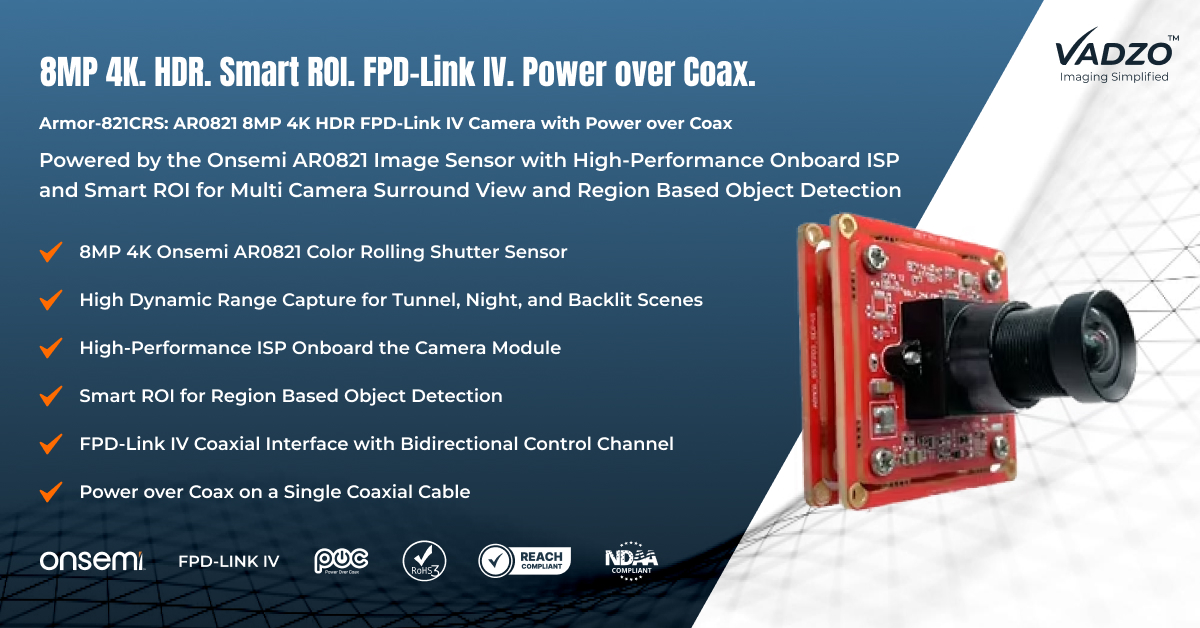 Vadzo Imaging's Armor-821CRS is an 8MP 4K HDR FPD-Link IV Camera built on the Onsemi AR0821 image sensor, combining a high-performance onboard ISP, Power over Coax delivery, and Smart ROI region selection in a single coaxial camera module. It is engineered for multi-camera surround view architectures, region-based object detection, and long-reach automotive vision deployments where video, bidirectional control, and power all travel over one coaxial conductor to a centralized compute platform.
FORT WORTH, TX / ACCESS Newswire / August 24, 2026 / Vadzo Imaging, a provider of embedded and machine vision camera products for OEMs and system integrators, today announces the launch of the Armor-821CRS, an AR0821 FPD-Link IV Camera developed for automotive vision engineers, ADAS system integrators, and embedded developers building surround view perception on centralized compute platforms. Built on the Onsemi AR0821 Camera sensor platform with a high-performance ISP resident on the module, the Armor-821CRS delivers processed 8MP 4K HDR frames over a single coaxial cable that also carries the control channel and the module supply voltage.
The Cabling, Power, and Compute Problem in Multi-Camera Automotive Vision
A vehicle running full perimeter perception carries four or more imaging nodes at the front fascia, both mirror housings, and the tailgate, each several meters from the compute module running the perception stack. Most embedded camera interfaces do not survive that separation. MIPI CSI-2 has a reach measured in centimeters. USB 3.x degrades past a few meters without active cabling and offers no automotive-grade locking connector. Network-based architectures insert a compression stage between the sensor and the inference engine, adding latency and encoding artifacts.
The harness is the second constraint. Every node requiring a separate power conductor adds mass, connector count, assembly labor, and one more sealed interface that can fail in the field.
The third constraint is bandwidth measured against available compute. An 8MP node streaming uncompressed 4K consumes a significant share of the link budget and a proportional share of the inference budget. In a Multi Camera Surround View System with four such nodes at full frame, the aggregate load exceeds what most centralized ADAS platforms process at the frame rates closed-loop functions require. Solving all three inside one production module is the problem the Armor-821CRS answers.
How FPD-Link IV and Power over Coax Change the System Architecture
FPD-Link is short for Flat Panel Display Link, a serializer and deserializer signaling standard developed to carry high-bandwidth video over a single low-cost cable. The fourth generation, written as FPD-Link IV and sometimes as FPD Link 4, extends forward channel bandwidth well beyond FPD-Link III on the same coaxial physical layer and bidirectional control architecture. The serializer on the camera module converts parallel sensor output into a high-speed serial stream, and the deserializer at the host reconstructs it for the compute platform. Vadzo's guide to FPD-Link camera products for machine vision covers the comparative analysis.
A SerDes link carries uncompressed video. There is no encode stage on the camera side and no decode stage on the host, so no compression artifacts reach the perception model, and no codec latency enters the control loop. For an Object Detection Automotive Camera feeding a safety-relevant function that is not academic, because compression artifacts cluster around high-contrast edges, exactly where small object detection degrades first. Vadzo's breakdown of FPD-Link and USB3 Vision compares both transport models.
The back channel is equally consequential. FPD-Link IV carries a bidirectional control path over the same coaxial conductor as the video, giving the host register-level access to the image sensor and the onboard ISP. Exposure adjustments, ISP parameter updates, and Smart ROI window definitions travel back up the cable the video comes down. As an AR0821 Flat Panel Display Link Camera, the Armor-821CRS presents one electrical interface to the vehicle, and any 8MP Flat Panel Display Link Camera built this way removes the separate video, control, and power conductors.
Power over Coax completes the single cable architecture. A PoC Camera receives its supply voltage over the same conductor that carries video and control, which leaves one connector and one cable per node instead of two. Across a four-node 360 Degree Surround View Camera installation, this removes four power conductors, four connectors, and the routing and sealing work each demands. As a Power over Coax Camera, the Armor-821CRS lowers the integration cost of every node added, which is what makes dense deployment viable at production volume.
Sensor and Camera Overview
The Armor-821CRS is built on the Onsemi AR0821, an AR0821 4K Image Sensor with a color rolling shutter architecture and integrated high dynamic range capture. As an AR0821 4K Color FPD Camera, it delivers full 4K resolution across the FPD-Link IV coaxial interface, with sensor output processed by a high-performance ISP resident on the module rather than on the host.
That ISP placement is deliberate. The host processor is the scarcest resource in a centralized ADAS architecture, and every demosaic, tone mapping, and HDR merge operation executed there is compute taken away from perception. Running the full pipeline on the module means this 8MP Color FPD IV Camera delivers finished frames to the deserializer and leaves the host free for inference. As an AR0821 HDR Color FPD Camera, the module performs the HDR merge in hardware close to the pixel array, where the raw exposure data already sits.
As an AR0821 HDR Rolling Shutter FPD Camera, the module captures multiple exposure levels within the rolling readout sequence and merges them on the module ISP, which lets an 8MP HDR Rolling Shutter FPD Camera hold detail across a tunnel exit without the sensitivity penalty a global shutter pixel imposes at the same pitch.
Rolling shutter readout suits the surround view function specifically. Surround view, parking assistance, and low-speed maneuvering operate where rolling shutter skew is not the dominant error term, and a rolling shutter pixel delivers higher fill factor and better low-light sensitivity per unit die area than a global shutter pixel. For an AR0821 Rolling Shutter Color FPD Camera covering a wide field at a vehicle corner, that trade favors sensitivity and resolution over shutter determinism, and the same reasoning holds for any 8MP Rolling Shutter Color FPD Camera used for perimeter coverage.
Key specs: 8MP 4K | AR0821 CMOS Sensor from Onsemi | Rolling Shutter | Color | HDR | High-Performance ISP | Smart ROI | FPD-Link IV Coaxial SerDes | Power over Coax | Operating Temperature of -40⁰C to 85⁰C
Key Capabilities of the Armor-821CRS 8MP 4K HDR FPD-Link IV Camera
8MP 4K Resolution for Wide Field of View Perimeter Coverage: Surround view optics are wide by necessity. Covering a full vehicle perimeter with four nodes forces each one to project a very wide horizontal field onto the sensor, spreading angular resolution thin at the frame edges where pedestrians and low obstacles appear. Resolution is the only lever that recovers it. At 8MP 4K, this 8MP 4K FPD IV Camera places roughly four times the pixel count of a 2MP node onto the same optical field, restoring pixels on target at the frame periphery. For an 8MP 4K Color FPD Camera feeding a detection network, that spatial sampling separates a reliable bounding box from a missed detection.
High Dynamic Range Capture for Tunnel, Night, and Backlit Transitions: Automotive scenes routinely exceed the dynamic range of a single exposure. A vehicle exiting a tunnel presents a dark interior and a sunlit exit in one frame. A single exposure clips one end or the other, and clipped regions carry no recoverable information. As an Automotive HDR Camera Module and an AR0821 4K HDR FPD Camera, the Armor-821CRS captures high dynamic range on the AR0821 and merges it on the module ISP, preserving shadow and highlight detail in the same frame. An 8MP HDR Color FPD Camera of this class holds usable content where a standard exposure returns none. Vadzo's guide to HDR camera types and how to choose covers the differences.
Smart ROI for Region-Based Object Detection Without Full-Frame Compute: Smart ROI addresses the compute constraint directly. Rather than streaming every pixel of every frame to the host and discarding most after inference, it lets the host define one or more regions of interest within the sensor array and read them at full resolution. The perception stack receives dense pixel data where the scene demands it and coarse or no data elsewhere. As a Region-Based Object Detection Camera, the Armor-821CRS turns resolution into a resource the host allocates dynamically rather than a fixed cost paid on every frame. For an AR0821 Color FPD IV Camera in a four-node system, this lets an 8MP sensor coexist with a compute budget sized for lower resolution inputs.
High-Performance Onboard ISP for Host Compute Offload: The ISP on the Armor-821CRS belongs to the camera module, not to the host SoC. That distinction determines where demosaicing, noise reduction, tone mapping, auto exposure, and HDR merge consume cycles. Run on the host, these operations compete directly with the perception network for memory bandwidth and accelerator time. Run on the module, the host receives frames ready for inference. As an AR0821 HDR FPD IV Camera, the Armor-821CRS keeps ISP cost constant per node and independent of the host platform chosen.
Single Cable FPD-Link IV Architecture with Power over Coax: Video, bidirectional control, and module power share one coaxial conductor. For the harness team, this collapses two cable runs and two connectors per node into one, and removes the local power regulation a separately powered node needs at each mounting position. It also simplifies EMC qualification, because there is a single shielded path into and out of each node. For an 8MP FPD Camera intended for production vehicle programs, this architecture is the difference between a module that demonstrates well on a bench and an 8MP FPD-Link IV Camera that survives the cost, mass, and reliability review preceding a production award.
Product Specifications
"Every surround view program we support hits the same wall at the same point. The perception team wants more resolution and better dynamic range at the corners of the vehicle, and the harness team tells them there is no mass budget and no connector budget for another four power conductors. FPD-Link IV with Power over Coax removes the argument. You get 8MP at the corner of the car on one coaxial cable, and Smart ROI lets the perception team request full resolution exactly where it matters without asking the compute platform for headroom it does not have. We built the Armor-821CRS because that conversation kept happening, and the hardware to end it was not available in a form OEM teams could buy and qualify." - Alwin Vincent, Product Manager, Vadzo Imaging.
Target Applications
Multi Camera Surround View and 360 Degree Perimeter Perception: A surround view installation stitches four wide-angle nodes into a continuous overhead view of the vehicle perimeter, and that stitch depends on consistent color response, exposure behavior, and geometry across all four. Mismatched auto white balance produces visible seams, and mismatched exposure produces brightness steps at the boundary. Module resident ISP processing on this ADAS Surround View Camera keeps that chain identical across every node. Deploying an identical AR0821 4K Rolling Shutter FPD Camera at each corner removes the calibration divergence that mismatched hardware introduces, and an 8MP 4K Rolling Shutter FPD Camera at every node keeps the composite consistent. As a Surround View Camera for Autonomous Vehicles, the Armor-821CRS delivers 8MP 4K per node with power and control on the video cable.
Region-Based Object Detection and ADAS Perception: Detection performance in ADAS is bounded by pixels on target at the distance at which a decision must be made. A pedestrian at the edge of a wide-angle frame occupies few pixels, and detection confidence falls sharply below a threshold pixel height. Smart ROI places full-resolution readout where that threshold is at risk without paying full frame bandwidth and inference cost across the entire field. As an AR0821 4K FPD IV Camera with region-based windowing, the Armor-821CRS lets accuracy and compute budget be traded region by region. For an AR0821 Rolling Shutter FPD IV Camera, the window is set in sensor rows and columns, so an 8MP Rolling Shutter FPD IV Camera holds full pixel density inside it.
Telematics, Fleet Management, and Commercial Vehicle Vision: Commercial vehicle programs deploy imaging for driver monitoring, blind spot coverage, cargo observation, and event recording, often on chassis where cable runs are far longer than in passenger vehicles. Single-cable telematics and fleet management camera architectures reduce installation labor per vehicle. The coaxial physical layer tolerates the long runs articulated chassis require, and Power over Coax removes the local power tap at each mounting position. For fleet management vision deployments, an Autonomous Vehicle Camera Module usable across autonomous and driver-operated platforms lets one baseline serve a mixed fleet.
Automation, Robotics, and Autonomous Industrial Vehicles: Autonomous mobile robots, automated guided vehicles, and industrial machinery face a smaller-scale version of the same problem. Multiple imaging nodes around a moving chassis, a central compute unit, and a routing environment where every conductor competes for space in the drag chain. For automation and robotics camera platforms, a coaxial single-cable architecture reduces connector count in a moving harness, where mechanical fatigue failures accumulate first. High dynamic range capture handles the transition between lit indoor aisles and daylight loading bays that industrial automation vision platforms cross repeatedly.
Security, Surveillance, and Smart City Infrastructure: Fixed infrastructure deployments meet the cabling problem in a different form. A pole- or gantry-mounted node sits far from the recording and analytics equipment, and running both power and video there is expensive civil work. Coaxial single cable installation reduces that work substantially, particularly in retrofit projects. For security and surveillance camera installations and smart city monitoring nodes, 8MP 4K resolution supports license plate legibility across a wider area per node, reducing total node count. High dynamic range capture handles the backlit and mixed illumination that dominates outdoor surveillance camera deployments.
Deserializer Pairing and Host Integration
An FPD-Link IV camera module is one half of a link. The other half is the deserializer at the host, and the pair must be matched for the link to train and lock. Integrators should confirm the deserializer part and host carrier configuration with Vadzo engineering before hardware is committed, because that selection determines the number of camera inputs per host, the aggregation topology across nodes, and the driver stack required on the compute platform. Teams evaluating the wider interface family can review Vadzo's SerDes camera series and HDR FPD-Link III camera portfolio, with guidance available through Vadzo technical support.
Why the Armor-821CRS Was Built This Way
The Armor-821CRS exists because surround view perception is constrained less by sensor availability than by everything around the sensor. Resolution and dynamic range are both available. What has been scarce is a way to place both at a vehicle corner without a harness penalty and without a compute penalty. An 8MP 4K HDR sensor, a module-resident ISP, Smart ROI windowing, and a single coaxial cable carrying video, control, and power address all three at once. For teams building the next generation of 4K HDR FPD-Link IV Camera architectures, this 8MP HDR FPD-Link IV Camera is built to be specified into a production program.
Frequently Asked Questions
Q: What is FPD-Link IV and how does it differ from FPD-Link III in automotive camera systems?
A: FPD-Link stands for Flat Panel Display Link, a serializer and deserializer standard that carries uncompressed high-bandwidth video over a single coaxial cable together with a bidirectional control channel. The fourth generation, written as FPD-Link IV or FPD-Link 4, raises forward channel bandwidth substantially over FPD-Link III while keeping the same coaxial physical layer, which allows higher-resolution sensors on existing cabling. The practical difference for an automotive program is resolution headroom. FPD-Link III comfortably carries 2MP class nodes, and pushing 8MP through it forces compromises in frame rate or bit depth. FPD-Link IV removes that ceiling, which is why an 8MP FPD Link 4 Camera is realistic here. Vadzo builds camera products across both generations, including its high dynamic range camera portfolio and the Armor-821CRS as an AR0821 FPD-Link 4 Camera where higher resolution nodes are specified.
Q: How does Power over Coax work in an automotive camera module and what does it save at the system level?
A: Power over Coax delivers the camera module supply voltage over the same coaxial conductor that carries video and control data. At the host end, a bias tee network injects direct current onto the line without disturbing the high-frequency serial signal, and at the camera end, a matching filter separates the supply from the serial data and routes it to module power regulation. The two coexist because they occupy entirely different frequency regions on the same conductor. The system-level saving is not primarily the cable. It is the connector, the sealing interface, the routing path, the assembly labor, and the qualification work a second conductor requires. In a four-node surround view installation, a PoC Camera architecture eliminates four power conductors and four connector interfaces, each one a potential ingress point and warranty item.
Q: Which 8MP 4K HDR camera module is best suited for multi-camera surround view systems in autonomous vehicles?
A: A surround view node in an autonomous or driver-assisted vehicle must satisfy several requirements at once: enough resolution to hold pixels on target at the periphery of a wide-angle field, high dynamic range to survive tunnel exits and night headlight glare, an interface that reaches several meters without compression, and a way to keep 8MP from overwhelming a compute platform shared across four nodes. Vadzo Imaging's Armor-821CRS satisfies all of these on one module, pairing the Onsemi AR0821 8MP 4K sensor with a high-performance ISP on the module, HDR capture and merge in hardware, Smart ROI for region-based readout, and an FPD-Link IV coaxial interface carrying video, control, and Power over Coax on one cable. As an 8MP 4K HDR FPD camera, it is positioned for perimeter perception rather than adapted from a general-purpose module. Evaluation units and specifications are available through the Vadzo online store.
Q: What is Smart ROI and how does region-based object detection reduce compute load in ADAS platforms?
A: Smart ROI is a sensor- and ISP-level capability that lets the host define one or more windows within the full pixel array and read them at full resolution while the rest of the frame is downsampled or not transmitted. Bandwidth and inference cost then scale with the area actually needed rather than with total sensor resolution. Perception requirements are not uniform across the frame. In a reversing maneuver, the region immediately behind the vehicle carries nearly all of the safety-relevant content, and in a lane change, the blind spot cone does. A Region-Based Object Detection Camera lets the host concentrate resolution on those regions as driving context changes. Vadzo's Armor-821CRS implements this as a Smart ROI Automotive Camera on an 8MP AR0821 sensor, so the full 8MP is available when the scene requires it, and only the relevant window is paid for when it does not.
Q: Should an automotive vision program choose a coaxial SerDes camera interface or a USB-based camera interface?
A: The two interfaces solve different problems, and the choice is usually settled by cable reach, connector requirements, and whether compression is acceptable. USB-based camera products are excellent where the host sits close to the sensor, and a standard driver stack is the integration path. They fit vehicle installations poorly because reach is limited and the connector family is not designed for automotive vibration and sealing. A coaxial SerDes interface such as FPD-Link IV is designed for the opposite conditions, carrying uncompressed video over multiple meters of automotive-grade coaxial cable with a locking connector, supplying module power on the same conductor, and providing register-level control back to the sensor. Vadzo compares these transport models in its analysis of FPD-Link vs USB3 Vision, and builds camera products on both, including the Armor-821CRS as an AR0821 FPD Camera for automotive and long-reach industrial programs.
Availability and Customization
The Armor-821CRS AR0821 8MP 4K HDR FPD-Link IV Camera is available for evaluation and OEM integration. To request specifications, deserializer pairing guidance, or an evaluation unit, contact the Vadzo Imaging team at [email protected] or through Vadzo Imaging.
Vadzo supports full OEM camera customization across the Armor series, including form factor modification and board redesign, firmware development and custom feature integration, lens holder and optical configuration, connector and harness variants, and enclosure design in IP-rated and non-IP-rated configurations. Deserializer selection and host integration support are available on request.
About Vadzo Imaging
Vadzo Imaging develops embedded and machine vision camera products for OEMs and system integrators building production-ready vision systems across automotive, industrial automation, robotics, healthcare, and smart infrastructure. The company's imaging platforms span USB, MIPI CSI-2, GigE, Wi-Fi, and SerDes interfaces. Vadzo also provides end-to-end imaging support including sensor integration, ISP tuning, firmware development, and SDK frameworks, giving engineering teams a single partner from evaluation through production. Learn more at www.vadzoimaging.com.
Media Contact
Alwin Vincent
Vadzo Imaging
Email: [email protected]
LinkedIn: Vadzo Imaging
YouTube: Vadzo Imaging
X: Vadzo Imaging
SOURCE: Vadzo Imaging